
Record date meaning in simple words: who gets the dividend
Record date: the cut-off day: if your name is on the company's list of shareholders that day, you get the dividend or bonus.

The story
two people, one chai stall
Riya's mum has heard about the dividend and wants to buy more shares. Riya brings the question to Sameer.
 Riya
Ma wants to know when to buy. We've fixed the record date: Friday, 7 August.
 Sameer
So she buys on the 7th?
RiyaToo late. Shares take one working day to reach a demat account. If she buys by Thursday the 6th, her name is on the list on the 7th.
SameerAnd if she buys on the 7th?
RiyaThen the 7th is the ex-date for her. She gets the shares, but not this dividend.
SameerWhat if she sells on the 7th?
RiyaShe still gets the dividend. She was on the list that day.
SameerSo the whole thing hinges on one date.
RiyaOne date, and one working day before it.
The grown-up version
same idea, exact words
The record date is the date on which a listed company takes the list of shareholders entitled to a corporate benefit such as a dividend, bonus issue or rights issue. The ex-date is the first trading day on which a buyer no longer gets that benefit; the stock exchanges announce it. With India's T+1 settlement, the ex-date usually falls on the record date itself, so to be on the list you generally need to buy at least one trading day before the record date.
Which rule asks for itRegulation 42, SEBI (LODR) Regulations, 2015: at least 3 working days' notice of the record date to the stock exchanges, not counting the day of notice or the record date (7 for schemes of arrangement), and at least 5 working days between two record dates. NSE has clarified that the 3 working days also run from the board or shareholder approval of the corporate action.
Spot it in the wild
a real annual report, a real page
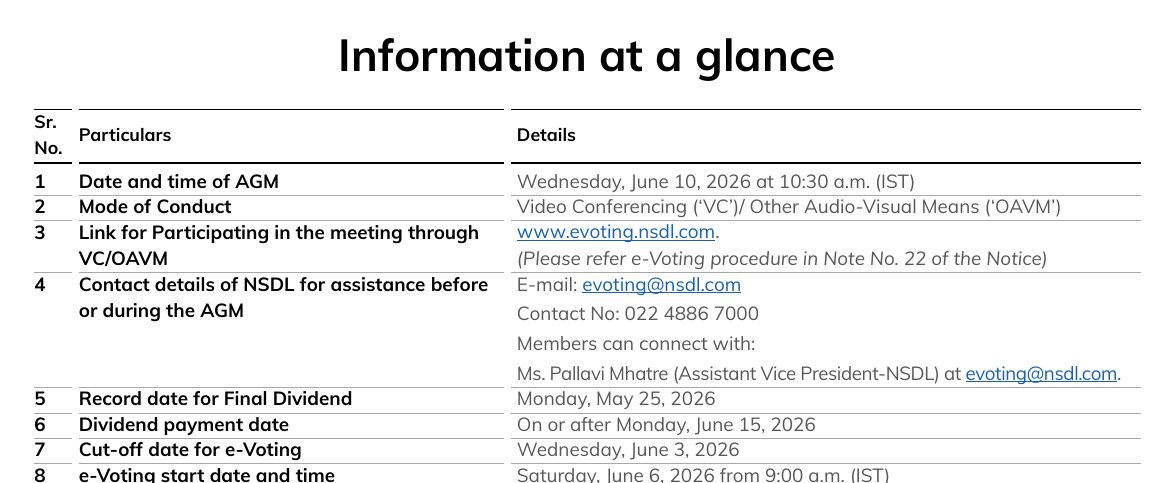
- The record date: holders on the list on 25 May 2026 get the dividend.
- The money arrives later, from 15 June, after the AGM approves it.
Don't mix it up
the usual confusions
Record date ≠ ex-date
The ex-date is the day the share starts trading without the dividend. Under T+1 it usually falls on the record date itself.
Record date ≠ payment date
The record date decides who gets paid. The money arrives later, on the payment date.
Record date ≠ book closure
Book closure is an older method: the share register is shut for a few days. Since SEBI dropped it from Regulation 42 in December 2024, listed companies announce a record date instead.
Three quick sips
no sign-up, nothing saved
Hindi mein

रिकॉर्ड डेट
रिकॉर्ड डेट वह तारीख़ है जिस दिन कंपनी देखती है कि शेयरधारक कौन हैं; उसी लिस्ट वालों को डिविडेंड या बोनस मिलता है।