
Value creation model meaning in simple words: the six capitals
Value creation model: the diagram in an integrated report that shows what a company puts in, what it does with it, and what comes out for its owners and everyone else.
The story
two people, one chai stall
Sameer is flipping through a big FMCG company's annual report. One page is a giant diagram with arrows.
 Sameer
What's this? It looks like a metro map.
 Riya
It's a value creation model. It shows what a company uses, what it does with it, and what comes out. They split the inputs into six "capitals".
SameerDo it for us.
RiyaFinancial capital: our cash and the bank loan. Manufactured: kiosks, kettles and vans. Intellectual: your masala recipe and the ordering app.
SameerAnd the people?
RiyaHuman capital: our staff, and what they know. Social and relationship: customers who come back every morning, and suppliers who trust us. Natural: the water, and the farms behind our milk and tea.
SameerThen the middle bit is us brewing and selling.
RiyaYes, that's the business model. Out come cups of chai, plus profit, wages, taxes. And used cups, which is the honest part.
SameerDo we have to publish one?
RiyaNo. In India it's voluntary. Big companies do it to show investors more than just profit.
The grown-up version
same idea, exact words
A value creation model summarises, usually as one diagram, the value creation process described in the International Integrated Reporting Framework. It shows the capitals a company uses as inputs (financial, manufactured, intellectual, human, social and relationship, and natural), the business model and activities that turn them into outputs, and the outcomes, which increase, decrease or transform those capitals. The Framework does not require companies to use these six categories. In India, integrated reporting is voluntary and no law requires it. A 2017 SEBI circular advised the top 500 listed companies to try it from FY2017-18; that circular has since been rescinded, but many large companies kept the format.
Which rule asks for itInternational <IR> Framework (revised January 2021), now under the IFRS Foundation; SEBI circular SEBI/HO/CFD/CMD/CIR/P/2017/10 of 6 February 2017 (voluntary adoption). No law in India requires it.
Spot it in the wild
a real annual report, a real page
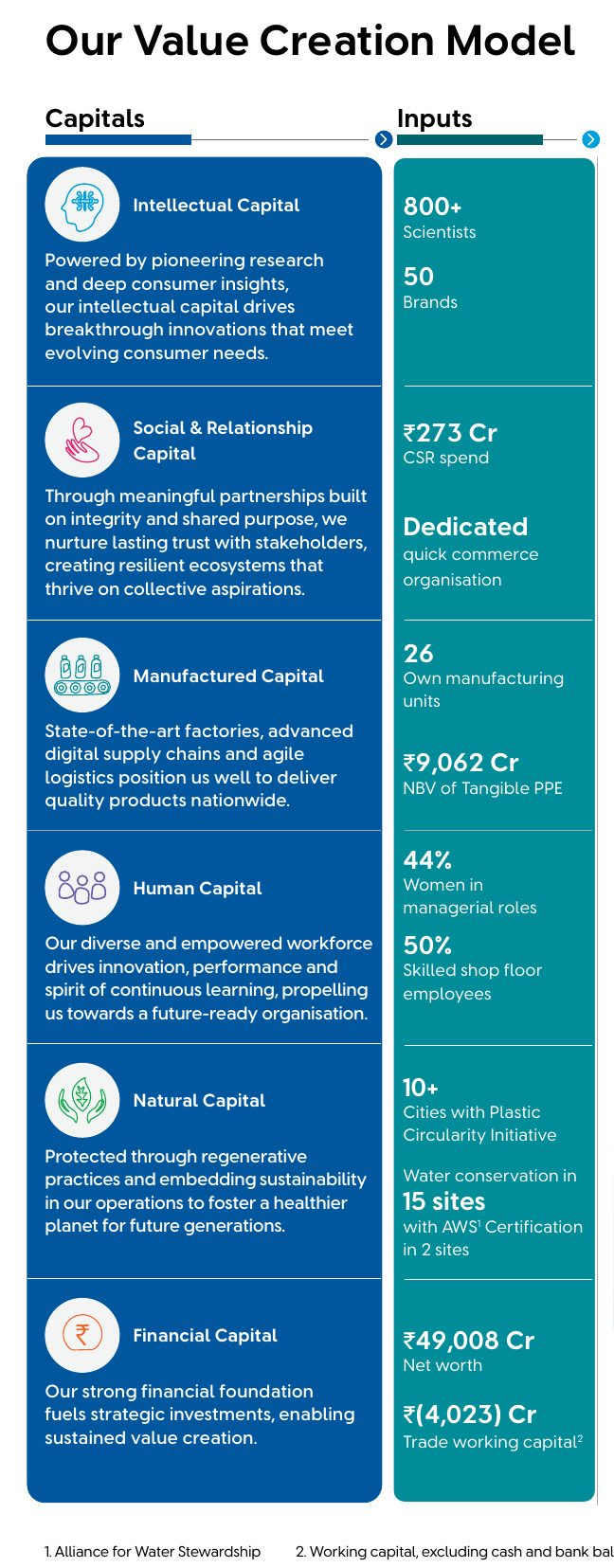
- Money is one input: ₹49,008 crore of net worth, the shareholders' money in the business.
- Nature counts as an input too, with water conservation at 15 sites.
Don't mix it up
the usual confusions
Value creation model ≠ BRSR
BRSR is a SEBI-mandated sustainability report in a fixed format for the top 1,000 listed companies. A value creation model is a voluntary diagram that each company designs its own way.
Value creation model ≠ business model
The business model is the middle of the diagram: how the company turns inputs into products. The value creation model adds what goes in and what comes out for everyone.
Value creation model ≠ outputs and outcomes
Outputs are what the company makes, like cups of chai sold. Outcomes are the effects on the capitals, like wages paid, profit earned or water used up.
Three quick sips
no sign-up, nothing saved
Hindi mein
वैल्यू क्रिएशन मॉडल
वैल्यू क्रिएशन मॉडल इंटीग्रेटेड रिपोर्ट का वह चित्र है जो दिखाता है कि कंपनी क्या लगाती है, उससे क्या करती है, और मालिकों व बाकी सबके लिए क्या निकलता है।
Sources
- Integrated Reporting by Listed Entities, circular dated 6 February 2017, SEBI (via NSE)
- Integrated Reporting Framework: FAQs, IFRS Foundation