Amortisation meaning in simple words: writing off intangibles
Amortisation: the cost of something you can't touch, like software or a licence, spread across the years it is useful.

The story
two people, one chai stall
Riya shows Sameer the new ordering app on her phone. It cost ₹2.5 crore to build.
 Sameer
₹2.5 crore for an app! Did that wipe out a big chunk of this year's profit?
 Riya
Only ₹50 lakh of it. We expect the app to be useful for five years, so we spread the cost: ₹0.5 crore a year. That's amortisation.
SameerIsn't that just depreciation?
RiyaSame idea, different word. Depreciation is for things you can touch, like kettles. Amortisation is for things you can't, like software, licences or brand rights.
SameerWhy five years? It's code. It doesn't rust.
RiyaNo, but it goes out of date. Phones change and customers expect new features. Five years is our best guess, and we review it every year.
SameerWhere do I see it?
RiyaThe P&L bundles them: depreciation and amortisation, ₹4 crore. ₹3.5 crore for the kiosks and vans, ₹0.5 crore for the app.
SameerSo the app quietly costs us ₹50 lakh of profit a year.
RiyaFor five years. By then we'll probably be building version two.
The grown-up version
same idea, exact words
Amortisation is the systematic allocation of the depreciable amount of an intangible asset with a finite useful life over that life. Under Ind AS 38 it begins when the asset is available for use, and the method should reflect the pattern in which the benefits are consumed; if that pattern cannot be determined reliably, the straight-line method is used. The period and method are reviewed at least at each financial year-end. Intangible assets with an indefinite useful life, and goodwill, are not amortised but tested for impairment.
Formula
Yearly amortisation (straight line) = (Cost − Residual value) ÷ Useful life. For most intangibles the residual value is nil.
Which rule asks for itInd AS 38, Intangible Assets; Schedule II, Companies Act, 2013 (which leaves intangible assets to the accounting standards).
Spot it in the wild
a real annual report, a real page
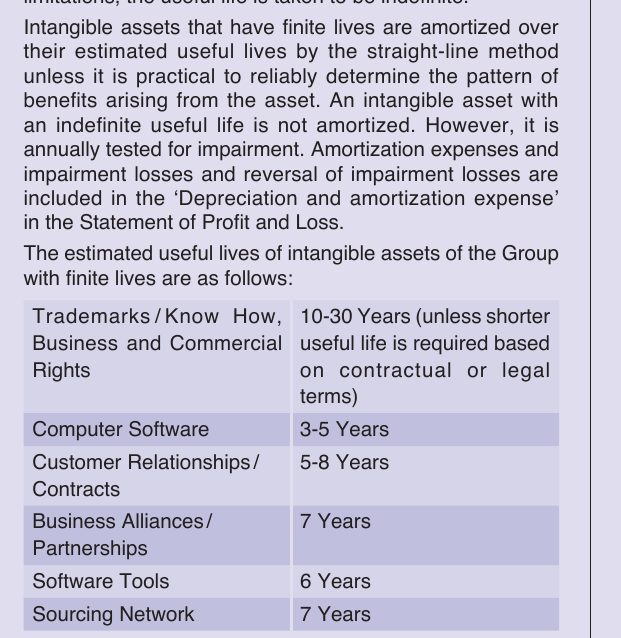
- Intangibles with a limited life are written off in equal yearly slices.
- ITC writes off computer software over 3 to 5 years.
Don't mix it up
the usual confusions
Amortisation ≠ depreciation
Same idea, different asset. Depreciation is for things you can touch, like kettles and vans. Amortisation is for things you can't, like software and licences.
Amortisation ≠ loan amortisation
Paying off a loan in instalments, like an EMI, is also called amortising it. That's about repaying debt, not spreading an asset's cost.
Amortisation ≠ amortised cost
A way of valuing loans and bonds on the balance sheet. It has nothing to do with wearing out software.
Three quick sips
no sign-up, nothing saved
Hindi mein
परिशोधन (अमॉर्टाइज़ेशन)
अमॉर्टाइज़ेशन यानी ऐसी चीज़ की क़ीमत, जिसे छू नहीं सकते, जैसे सॉफ़्टवेयर या लाइसेंस, उसके काम आने वाले सालों में बाँटकर ख़र्च दिखाना।
Sources
- Ind AS 38, Intangible Assets (Board of Studies lecture), ICAI
- Schedule II of the Companies Act, 2013: useful lives, ICAI Palakkad Branch