
Depreciation meaning in simple words: wear and tear in accounts
Depreciation: the cost of something a business uses for years, like a kettle or a kiosk, spread across those years instead of counted all at once.

The story
two people, one chai stall
Sameer is reading the FY26 profit and loss. One line puzzles him.
 Sameer
Depreciation, ₹3.5 crore. We didn't pay anyone ₹3.5 crore this year.
 Riya
No. It's the wear and tear on our kiosks, kettles and vans. We paid for them when we bought them. Depreciation spreads that cost over the years they work for us.
SameerWhy not count it all when we buy them?
RiyaRemember the first stall? You bought ₹1.5 lakh of kit. Count it all in year one and that year looks awful, the next four too good. So we took ₹30,000 a year for five years.
SameerAnd the kiosks get the same treatment.
RiyaYes. ₹3.5 crore this year. Add ₹0.5 crore for the ordering app, which is called amortisation, and you get the ₹4 crore line.
SameerDoes it come out of the bank?
RiyaOut of profit, not the bank. EBITDA of ₹18 crore becomes ₹14 crore of operating profit. The cash left when we bought the kit.
SameerSo our kiosks are melting at ₹3.5 crore a year.
RiyaSlowly. That's why we keep buying new ones.
The grown-up version
same idea, exact words
Depreciation is the systematic allocation of the depreciable amount of an item of property, plant and equipment (its cost less residual value) over its useful life. It is charged to profit and loss each year and reduces the asset's carrying amount, but involves no cash outflow; the cash left when the asset was bought. Land is generally not depreciated. Schedule II of the Companies Act, 2013 sets indicative useful lives, such as 15 years for general plant and machinery; a company that uses a different life must disclose it and justify it with technical advice.
Formula
Yearly depreciation (straight line) = (Cost − Residual value) ÷ Useful life
Which rule asks for itInd AS 16, Property, Plant and Equipment; Schedule II, Companies Act, 2013 (useful lives).
Spot it in the wild
a real annual report, a real page
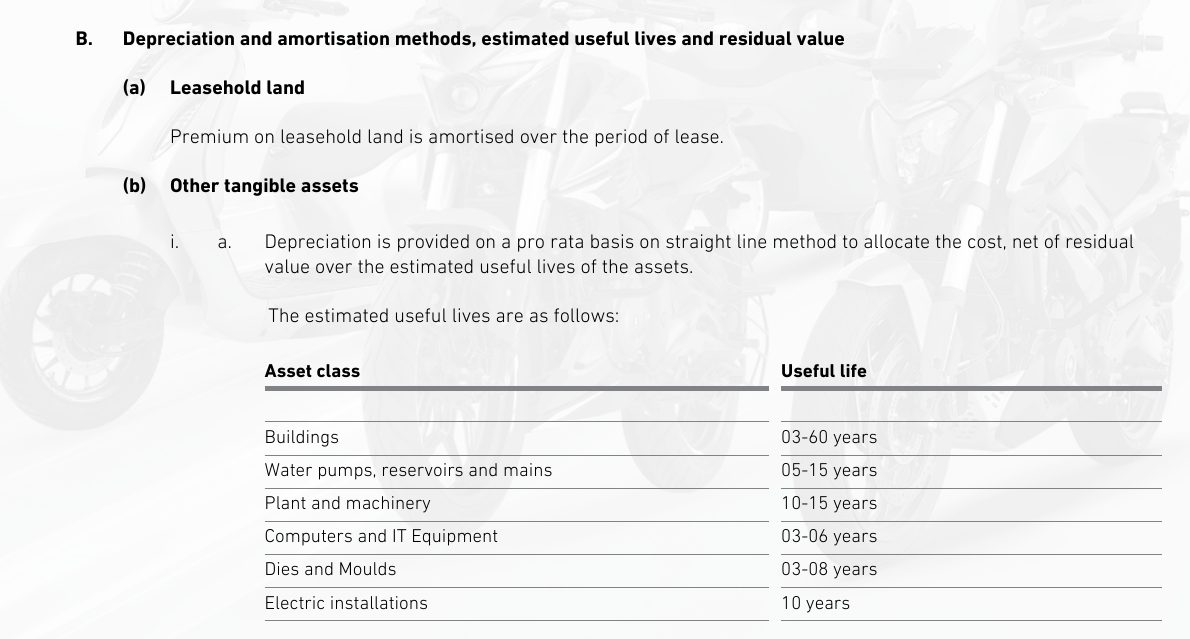
- Bajaj Auto spreads each asset's cost evenly over its life: the straight-line method.
- Factory machines are written off over 10 to 15 years, computers over 3 to 6.
Don't mix it up
the usual confusions
Depreciation ≠ capex
Capex is the cash spent buying the kiosk, in the year you buy it. Depreciation spreads that same cost through the P&L over the kiosk's life.
Depreciation ≠ amortisation
Same idea, different kind of asset. Depreciation is for things you can touch, like vans. Amortisation is for things you can't, like software.
Depreciation ≠ fall in resale value
Depreciation isn't what the van would fetch if sold today. It's a planned spread of what it cost, based on how long it should last.
Three quick sips
no sign-up, nothing saved
Hindi mein
मूल्यह्रास (डेप्रिसिएशन)
डेप्रिसिएशन यानी किसी कई साल चलने वाली चीज़, जैसे केतली या कियोस्क, की क़ीमत को एक साथ नहीं, बल्कि उन सालों में बाँटकर ख़र्च दिखाना।