Operating profit (EBIT) meaning in simple words, with example
Operating profit (EBIT): what a company's main business earns after its running costs and the wear and tear on its equipment, before interest and tax.

The story
two people, one chai stall
A fund manager wants to know which half of the business makes money. Sameer turns to Riya.
 Sameer
She asked for our EBIT. Isn't that just EBITDA with a typo?
 Riya
Close, but it's one step further down. EBIT is earnings before interest and tax. We take off the wear and tear first.
SameerHow much?
RiyaEBITDA is ₹18 crore. Kiosks, kettles and vans wearing out, plus writing off the ordering app, cost ₹4 crore. So EBIT is ₹14 crore.
SameerWhy does she want that one?
RiyaIt's what the chai business earns once you count the kit it uses up, before the bank and the taxman. A rival with a big loan can be compared with us fairly.
SameerAnd the two halves?
RiyaStalls made ₹12 crore of EBIT on ₹100 crore of sales. Office and café supply made ₹2 crore on ₹20 crore.
SameerSo the stalls earn 12 paise a rupee, the offices 10.
RiyaExactly. Then interest of ₹2 crore takes us to ₹12 crore before tax.
The grown-up version
same idea, exact words
EBIT means earnings before interest and tax. It is usually calculated as profit before tax plus finance costs, and companies differ on whether they include other income, such as interest earned on deposits. Ind AS 1, which applies today, does not define operating profit, so a company that reports EBIT should explain how it measures it. A new standard, Ind AS 118 (based on IFRS 18), would add a defined 'operating profit' subtotal. In December 2025 the National Financial Reporting Authority recommended it to the Ministry of Corporate Affairs for periods beginning on or after 1 April 2027, but it applies only once the Ministry notifies it, and we could find no such notification as of November 2026.
Formula
EBIT = Profit before tax + Finance costs (− Other income, if excluded). EBIT margin = EBIT ÷ Revenue.
Which rule asks for itNot defined in Ind AS 1 or Schedule III (Division II), Companies Act, 2013. Segment results under Ind AS 108 are often reported at this level. Ind AS 118 has been recommended by NFRA for periods from 1 April 2027 but, as far as we could find, not yet notified by MCA.
Spot it in the wild
a real annual report, a real page
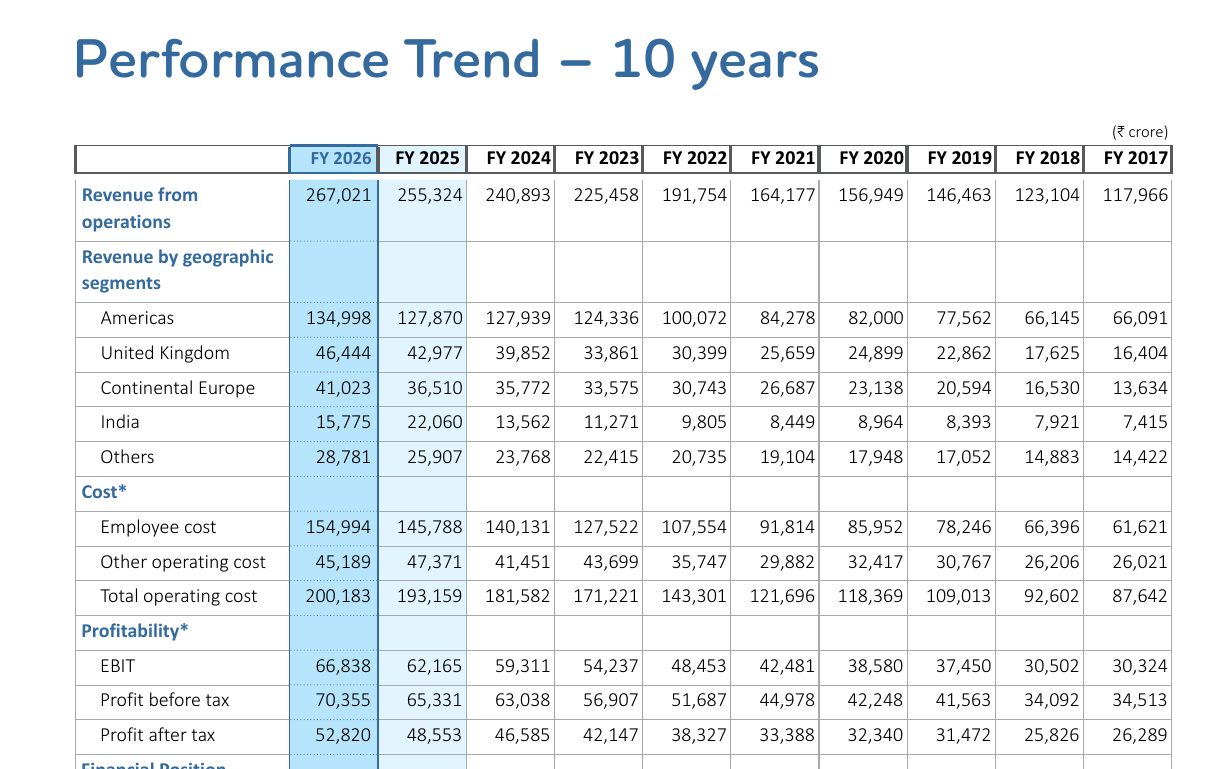
- Revenue in FY26: ₹2,67,021 crore.
- EBIT: ₹66,838 crore, about 25 paise of operating profit on every rupee of revenue.
Don't mix it up
the usual confusions
Operating profit (EBIT) ≠ EBITDA
EBITDA comes before depreciation and amortisation; EBIT comes after. Sameer Chai's EBITDA is ₹18 crore, its EBIT ₹14 crore.
Operating profit (EBIT) ≠ profit before tax
Profit before tax also takes off interest. Sameer Chai's ₹14 crore EBIT minus ₹2 crore interest gives ₹12 crore.
Operating profit (EBIT) ≠ 'operating profit' in older tables
Some companies use 'operating profit' to mean EBITDA, before depreciation. Always check which costs a table has taken off.
Three quick sips
no sign-up, nothing saved
Hindi mein

ऑपरेटिंग प्रॉफ़िट (EBIT)
ऑपरेटिंग प्रॉफ़िट यानी EBIT: कंपनी का मुख्य कारोबार रोज़ के ख़र्च और मशीनों की घिसाई निकालने के बाद, ब्याज और टैक्स से पहले कितना कमाता है।
Sources
- Exposure Draft of Ind AS 118, Presentation and Disclosure in Financial Statements, ICAI
- Record note of the 22nd meeting of NFRA, 22 December 2025 (recommendation on Ind AS 118), National Financial Reporting Authority