
Segment reporting meaning in simple words: profit by business
Segment reporting: a company breaking its revenue and profit into its main lines of business, so you can see which parts earn what.

The story
two people, one chai stall
An analyst emails asking how the office supply business is doing. Sameer forwards it to Riya.
 Sameer
She wants office supply on its own. Don't we just report one big number?
 Riya
No, we report by segment: each main line of business, the way you and the board track it.
SameerSo, stalls and office supply.
RiyaStalls brought in ₹100 crore of revenue and ₹12 crore of operating profit. Office and café supply brought in ₹20 crore and ₹2 crore.
SameerSo supply is a sixth of our sales but only a seventh of our profit.
RiyaExactly. Stalls make 12 paise on every rupee, supply makes 10. Without segments, nobody outside could see that.
SameerCould we hide a weak business by lumping it in with the stalls?
RiyaNot easily. Any line that's 10% or more of revenue, profit or assets usually has to stand on its own. Supply is about 17% of our sales, so it qualifies.
SameerAnd the analyst gets her answer.
RiyaEvery quarter, in our results.
The grown-up version
same idea, exact words
Under Ind AS 108, an operating segment is a part of a company whose results are regularly reviewed by its chief operating decision maker to allocate resources and assess performance. A segment must be reported separately if its revenue, its profit or loss, or its assets are 10% or more of the combined figure for all segments, and further segments must be reported until they cover at least 75% of the company's external revenue. Listed companies with more than one reportable segment also publish segment information with their quarterly and annual results, in a format SEBI prescribes.
Formula
Segment margin = Segment result ÷ Segment revenue
Which rule asks for itInd AS 108, Operating Segments; Regulation 33, SEBI (LODR) Regulations, 2015, with SEBI's format for segment results.
Spot it in the wild
a real annual report, a real page
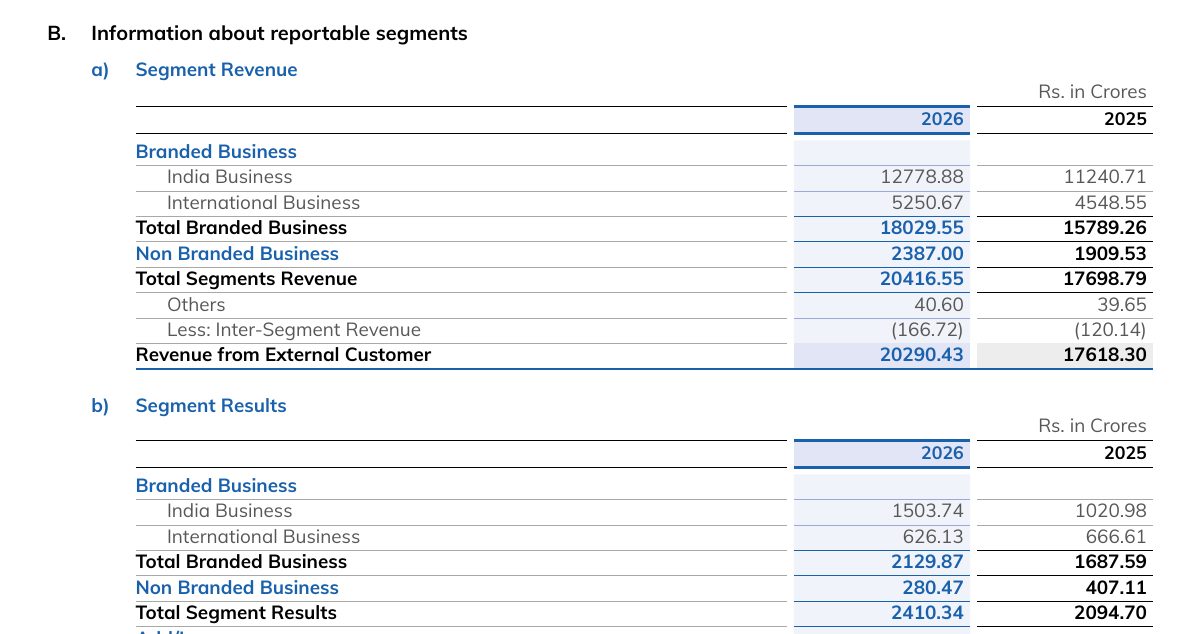
- Branded sales: India ₹12,779 crore, international ₹5,251 crore.
- International segment profit fell to ₹626 crore from ₹667 crore, even though its sales grew.
Don't mix it up
the usual confusions
Segment reporting ≠ consolidated vs standalone
That's about which companies are added together. Segments split the business by activity or region, whichever company it sits in.
Segment reporting ≠ subsidiary
A segment isn't a separate company. One company can have several segments, and one segment can run across several companies.
Segment reporting ≠ segment result vs company profit
Some costs, like head office, often aren't given to any segment. So segment results can add up to more than the company's operating profit.
Three quick sips
no sign-up, nothing saved
Hindi mein

सेगमेंट रिपोर्टिंग (खंडवार रिपोर्टिंग)
सेगमेंट रिपोर्टिंग में कंपनी अपनी कमाई और मुनाफ़े को मुख्य कारोबारों में बाँटकर दिखाती है, ताकि पता चले कौन-सा हिस्सा कितना कमाता है।