
Consolidated vs standalone meaning in simple words: which to read
Consolidated vs standalone: the two sets of accounts a parent company publishes: standalone for the company alone, consolidated for the whole group with its subsidiaries.

The story
two people, one chai stall
The annual report proofs arrive. Sameer finds two sets of accounts and frowns.
 Sameer
Why do we print our accounts twice? Revenue is ₹120 crore here and ₹128 crore there.
 Riya
One is standalone: Sameer Chai Ltd alone, the stalls and office supply. The other is consolidated: the whole family, including Sameer Chai Foods, our premix company.
SameerWe own all of Foods. Isn't it just us?
RiyaLegally it's a separate company with its own books. Its ₹8 crore of sales and ₹0.5 crore of profit show up only when we add the family together. So consolidated revenue is ₹128 crore and profit is ₹9.5 crore.
SameerWhat if Foods sold premix to our stalls?
RiyaThen we'd strip those sales out, so the group isn't counting money it paid itself. This year there weren't any.
SameerWhich one should an investor read?
RiyaUsually consolidated, because it shows everything the company controls. But standalone shows what the parent earns by itself, and dividends are paid out of the parent's own profit.
The grown-up version
same idea, exact words
Standalone financial statements present a company as a single legal entity, with its investments in subsidiaries shown as investments. Consolidated financial statements present the parent and its subsidiaries as one economic entity: their items are combined line by line, transactions and balances within the group are eliminated, and the part of subsidiaries owned by outsiders is shown as non-controlling interest. Under Section 129(3) of the Companies Act, 2013, a company with one or more subsidiaries must prepare consolidated statements in addition to its standalone ones and lay both before the AGM. A listed company with subsidiaries must also file consolidated results every quarter.
Formula
Consolidated revenue = Parent + subsidiaries − sales within the group
Which rule asks for itSection 129(3), Companies Act, 2013; Ind AS 110, Consolidated Financial Statements; Regulation 33(3), SEBI (LODR) Regulations, 2015.
Spot it in the wild
a real annual report, a real page
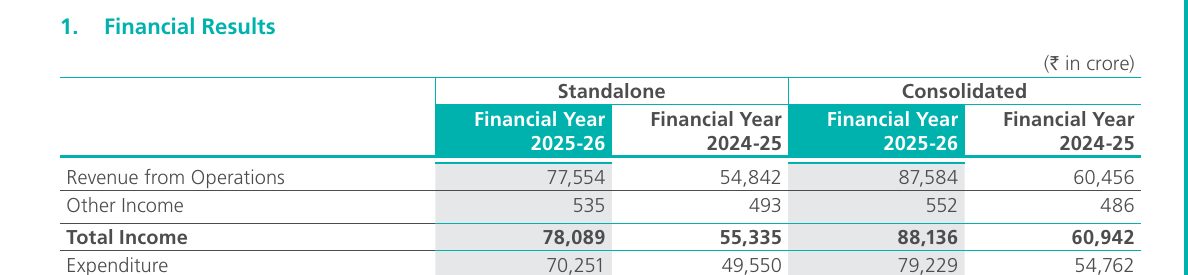
- Titan on its own: ₹77,554 crore of revenue in FY26.
- With its subsidiaries added: ₹87,584 crore, about ₹10,000 crore more.
Don't mix it up
the usual confusions
Consolidated vs standalone ≠ subsidiary vs associate
A subsidiary is controlled, so all of its numbers are added in line by line. An associate is only influenced, often a 20% to 50% stake, so just the parent's share of its profit is added.
Consolidated vs standalone ≠ segment reporting
Consolidation adds separate companies together. Segment reporting splits the business by activity, like stalls and office supply, whatever company it sits in.
Three quick sips
no sign-up, nothing saved
Hindi mein

कंसॉलिडेटेड बनाम स्टैंडअलोन
स्टैंडअलोन खाते सिर्फ़ मूल कंपनी के होते हैं, जबकि कंसॉलिडेटेड खाते उसकी सब्सिडियरी कंपनियों को मिलाकर पूरे ग्रुप के।