Buyback meaning in simple words: a company buying its own shares
Buyback: a company uses its cash to buy some of its own shares back from shareholders, and then cancels them.
The story
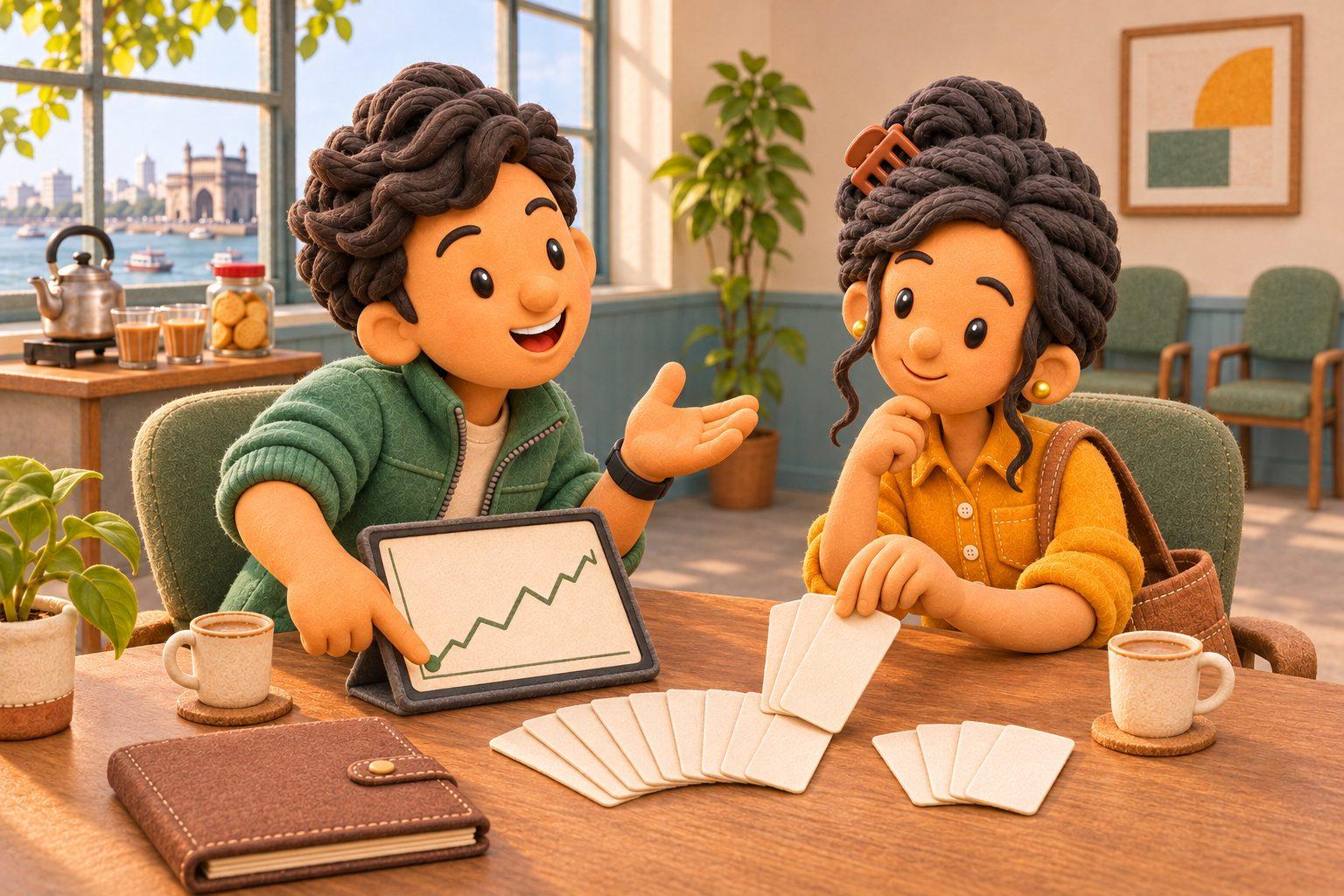
two people, one chai stall
A "what if" for FY27. Sameer Chai has cash in the bank, and Sameer thinks the share price is too low.
 Sameer
Our shares are at ₹54. I think we're worth more. Can we buy some back?
 Riya
That's a buyback. Say 25 lakh shares at ₹60 each. That's ₹15 crore of our cash.
SameerWhy pay ₹60 when the screen says ₹54?
RiyaTo tempt people to sell. It would be a tender offer: every shareholder can offer shares, and we take them in proportion. 15% is kept for small holders, like my mum.
SameerWhat happens to the shares we buy?
RiyaThey're cancelled. 5 crore shares become 4.75 crore. The same profit is shared over fewer shares, so EPS goes up a little.
SameerCan the board just decide?
RiyaOnly up to 10% of capital plus free reserves, which is ₹11 crore. ₹15 crore is above that, so shareholders must pass a special resolution.
SameerAnd if I don't sell mine?
RiyaThen your 3 crore shares out of 4.75 crore become a bigger slice: about 63%.
The grown-up version
same idea, exact words
A buyback is a company's purchase of its own shares, which are then extinguished. It can be up to 25% of paid-up capital and free reserves (which here include the securities premium), but above 10% shareholders must approve it by special resolution; debt afterwards can't exceed twice capital and free reserves. In a tender offer, shareholders offer shares in proportion to their holdings, and 15% is reserved for small shareholders, whose holdings are worth up to ₹2 lakh. Buybacks through the stock exchange were stopped from 1 April 2025 and allowed again from 1 August 2026, for less than 15% of capital and free reserves.
Formula
Buyback size ≤ 25% × (Paid-up capital + Free reserves). Board approval alone: up to 10%.
Which rule asks for itSections 68, 69 and 70, Companies Act, 2013; Regulations 4, 5 and 6, SEBI (Buy-back of Securities) Regulations, 2018 (last amended July 2026).
Spot it in the wild
a real annual report, a real page
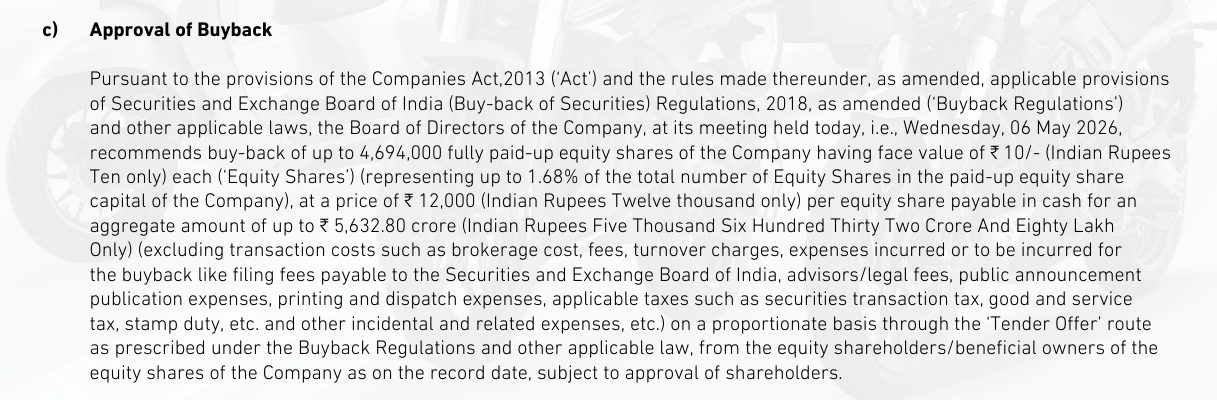
- The Board's plan: buy back up to 46.94 lakh shares (1.68% of all shares) at ₹12,000 each.
- It's a tender offer: every shareholder can offer shares, in proportion to what they hold.
Don't mix it up
the usual confusions
Buyback ≠ dividend
A dividend pays every shareholder. A buyback pays only those who sell their shares back.
Buyback ≠ open-market buyback
In a tender offer, the company names a price and shareholders tender shares to it. In an open-market buyback, it buys on the stock exchange over time at market prices.
Buyback ≠ rights issue
A rights issue takes money in from shareholders for new shares. A buyback sends money out and cancels shares.
Three quick sips
no sign-up, nothing saved
Hindi mein
बायबैक (शेयर पुनर्खरीद)
बायबैक में कंपनी अपने नकद पैसे से शेयरधारकों से अपने ही कुछ शेयर वापस ख़रीदती है और फिर उन्हें रद्द कर देती है।