
Cash flow statement meaning in simple words, with an example
Cash flow statement: shows where a company's cash came from and where it went during the year, split into everyday business, investing and financing.

The story
two people, one chai stall
April. The new kiosks are open, but the bank balance looks thinner. Sameer is worried.
 Sameer
We made ₹9 crore of profit. So why do we have less cash than last year?
 Riya
Because profit and cash are different. The cash flow statement shows where every rupee actually went.
SameerGo on, then.
RiyaPart one is operations. Selling chai brought in ₹14 crore of cash, after tax and ₹1 crore more tied up in stock and bills.
SameerGood. And part two?
RiyaInvesting. We spent ₹15 crore on 15 new kiosks and the van fleet. That's more than the chai brought in.
SameerWorth it, though. And part three?
RiyaFinancing. Last year's dividend, interest and repaying some of the loan: ₹7 crore out.
SameerSo 14 in, 22 out.
RiyaDown ₹8 crore. We started the year with ₹63 crore and ended with ₹55 crore. No mystery, no leak. We just spent on growth.
SameerI'll stop checking the bank app every hour, then.
The grown-up version
same idea, exact words
The statement of cash flows reports a company's cash receipts and payments for the period, classified into operating, investing and financing activities, and reconciles the opening and closing cash and cash equivalents. Ind AS 7 allows operating cash flow to be shown by the direct method or by the indirect method, which starts from profit and adjusts for non-cash items and working-capital changes; listed companies must use the indirect method in their annual report. It is part of the financial statements under the Companies Act; one person companies, small companies and dormant companies may leave it out, and an MCA exemption extends this to private companies recognised as start-ups.
Formula
Net change in cash = Cash from operating activities + Cash from investing activities + Cash from financing activities
Which rule asks for itSection 2(40), Companies Act, 2013 (cash flow statement as part of the financial statements, and its exemptions); Ind AS 7, Statement of Cash Flows; Regulation 34(2)(c), SEBI (LODR) Regulations, 2015 (indirect method for listed companies).
Spot it in the wild
a real annual report, a real page
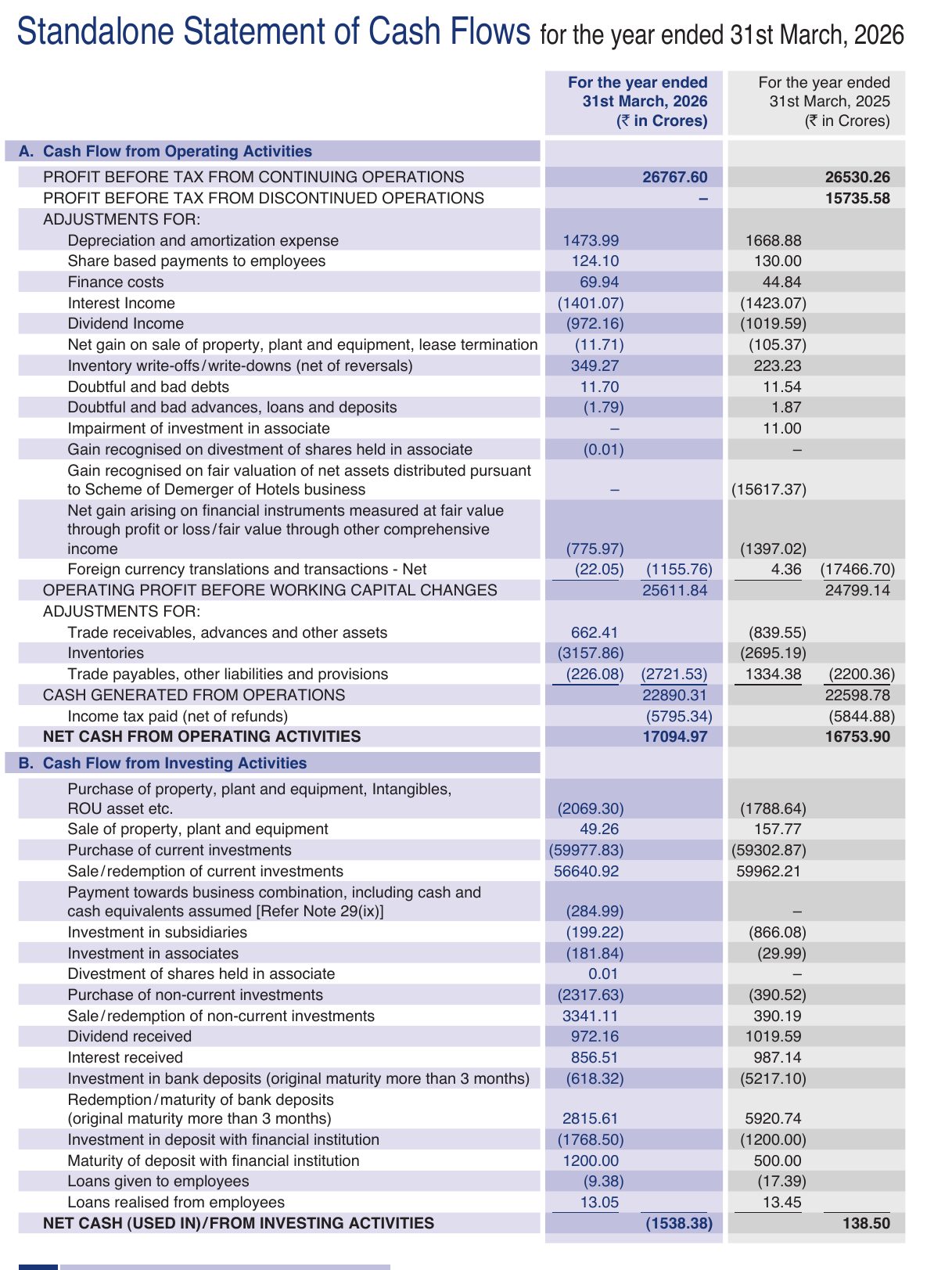
- Cash from the everyday business: about ₹17,095 crore, after paying ₹5,795 crore of tax.
- Investing used about ₹1,538 crore, including ₹2,069 crore on plant, equipment and other assets.
Don't mix it up
the usual confusions
Cash flow statement ≠ profit
Profit counts sales when they are made and costs like depreciation that never leave the bank. The cash flow statement counts only money actually received or paid.
Cash flow statement ≠ free cash flow
Free cash flow is one number worked out from the statement: cash from operations minus capex. Sameer Chai's is ₹14 crore − ₹15 crore = −₹1 crore.
Cash flow statement ≠ balance sheet
The balance sheet shows the cash on one day (₹55 crore on 31 March). The cash flow statement explains how it got there from ₹63 crore.
Three quick sips
no sign-up, nothing saved
Hindi mein

कैश फ़्लो स्टेटमेंट (नकदी प्रवाह विवरण)
कैश फ़्लो स्टेटमेंट बताता है कि साल भर में कंपनी के पास नकद पैसा कहाँ से आया और कहाँ गया: रोज़ के कारोबार, निवेश और फ़ाइनेंसिंग में।