
Working capital meaning in simple words, with an example
Working capital: what a company has in short-term assets, like stock, customer dues and cash, minus the bills it must pay within a year.
The story
two people, one chai stall
The milk supplier's invoice arrives. Sameer reaches for his phone to pay it.
 Sameer
We owe the milk and tea suppliers ₹10 crore. Shouldn't we pay it all today?
 Riya
Those bills are due over the next few weeks. That gap is how we run on working capital.
SameerMeaning?
RiyaShort-term stuff we have, minus short-term bills. We have ₹5 crore of stock, ₹5 crore owed by cafés and ₹55 crore of cash: ₹65 crore. We owe suppliers ₹10 crore and other bills ₹5 crore: ₹15 crore.
SameerSo ₹50 crore. Comfortable.
RiyaMostly thanks to the IPO cash. Leave the cash out and it's ₹10 crore minus ₹15 crore: minus ₹5 crore.
SameerMinus? Are we in trouble?
RiyaThe opposite. A customer pays for chai the moment she drinks it. We pay for the milk weeks later. Our suppliers are quietly funding the stalls.
SameerFree money from the dairy.
RiyaNot free. Just good timing. Pay on the due date, and keep it that way.
The grown-up version
same idea, exact words
Working capital is current assets less current liabilities. Under Ind AS 1, an asset or liability is current if it is expected to be realised or settled within twelve months or within the company's normal operating cycle; Schedule III requires the balance sheet to show current and non-current items separately. Analysts often look at working capital excluding cash and investments, which shows how much money the day-to-day cycle of stock, customer dues and supplier credit ties up. The term itself is not defined in the Companies Act.
Formula
Working capital = Current assets − Current liabilities. Current ratio = Current assets ÷ Current liabilities.
Which rule asks for itNot defined in the Companies Act, 2013. Current and non-current classification: Ind AS 1, Presentation of Financial Statements (paras 66–76), and Schedule III (Division II), Companies Act, 2013.
Spot it in the wild
a real annual report, a real page
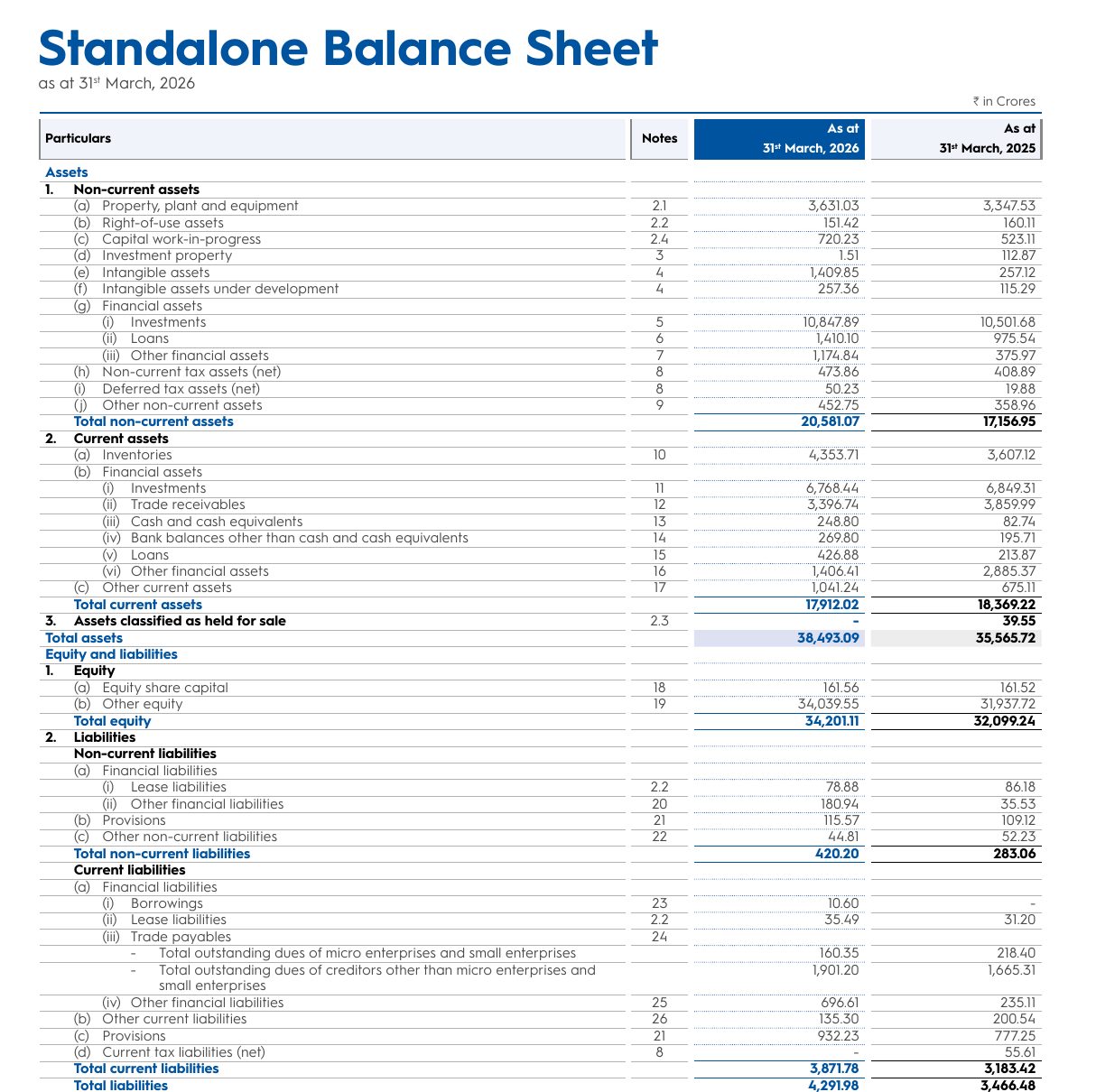
- Current assets: stock, money customers owe, cash and short-term investments, ₹17,912 crore.
- Current liabilities: bills due within a year, ₹3,872 crore. The gap, about ₹14,040 crore, is working capital.
Don't mix it up
the usual confusions
Working capital ≠ working capital loan
A working capital loan is a short-term bank loan to fund stock and customer dues. Working capital is the gap itself, however it's funded.
Working capital ≠ cash
Cash is only one part of current assets. Sameer Chai's ₹50 crore of working capital is mostly IPO cash; without it, the figure is −₹5 crore.
Working capital ≠ negative working capital
It isn't always a warning sign. A business whose customers pay at once but whose suppliers wait a few weeks, like a chai stall, often runs below zero.
Three quick sips
no sign-up, nothing saved
Hindi mein
वर्किंग कैपिटल (कार्यशील पूंजी)
वर्किंग कैपिटल यानी कंपनी की थोड़े समय की संपत्तियाँ, जैसे स्टॉक, ग्राहकों का बकाया और नकद, घटा वे बिल जो उसे एक साल के अंदर चुकाने हैं।
Sources
- Companies Act, 2013, India Code