
Contingent liability meaning in simple words: the maybe bill
Contingent liability: a possible bill that a company may or may not have to pay, depending on how a dispute or other uncertain event turns out.

The story
two people, one chai stall
A letter from the GST department lands on Riya's desk. Sameer reads it twice.
 Sameer
They say we owe ₹1.2 crore more GST. We don't!
 Riya
Our tax advisers agree with you, so we're disputing it. But we still have to tell shareholders.
SameerDo we put ₹1.2 crore on the balance sheet as money we owe?
RiyaOnly if we thought we'd probably lose. Right now it's a possible bill, not a likely one. So it goes in the notes, as a contingent liability.
SameerContingent?
RiyaIt depends on something that hasn't happened yet. Here, how the dispute ends.
SameerThen why mention it at all?
RiyaBecause the chance isn't tiny. If we lost, ₹1.2 crore is about 13% of a year's profit. Investors deserve to know.
SameerAnd a silly claim with no real chance?
RiyaIf the chance is remote, we needn't list it. But if our lawyers later say we'll probably lose, it moves onto the balance sheet as a provision, and it hits profit.
The grown-up version
same idea, exact words
Under Ind AS 37, a contingent liability is either a possible obligation from past events whose existence will be confirmed only by uncertain future events not wholly within the company's control, or a present obligation that is not recognised because an outflow is not probable or the amount cannot be measured reliably. It is not recognised on the balance sheet. It is disclosed in the notes unless the possibility of an outflow is remote. If an outflow becomes probable and can be reliably estimated, a provision is recognised instead.
Which rule asks for itInd AS 37, Provisions, Contingent Liabilities and Contingent Assets (paragraphs 10, 27, 28 and 86).
Spot it in the wild
a real annual report, a real page
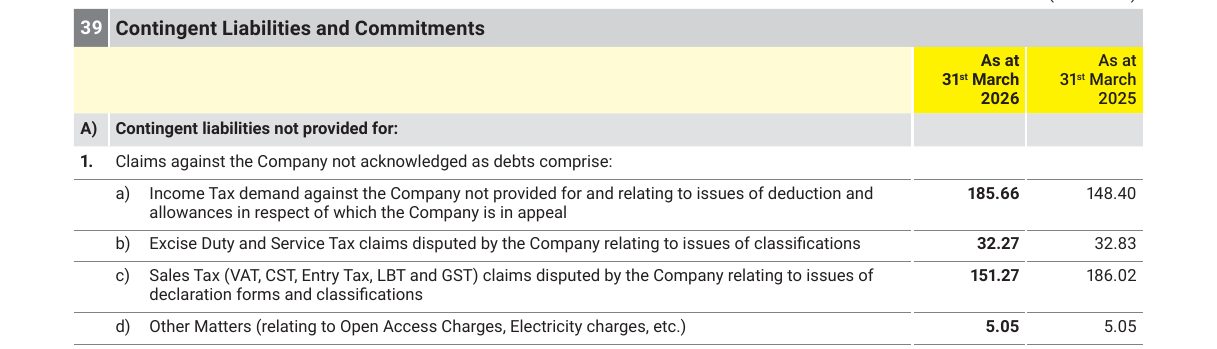
- Income tax demands Pidilite is appealing: ₹185.66 crore. 'Not provided for' means not booked as a liability.
- Disputed sales tax and GST claims: ₹151.27 crore, down from ₹186.02 crore a year earlier.
Don't mix it up
the usual confusions
Contingent liability ≠ provision
A provision is a bill the company will probably pay. It's booked on the balance sheet and reduces profit. A contingent liability sits only in the notes.
Contingent liability ≠ commitment
A commitment is money already promised under a contract, like kiosks on order. It isn't a dispute; the company knows it will pay.
Contingent liability ≠ contingent asset
The mirror image: a possible gain, like a claim the company may win. It is disclosed only when likely, and booked only when virtually certain.
Three quick sips
no sign-up, nothing saved
Hindi mein

आकस्मिक देनदारी (कंटिंजेंट लायबिलिटी)
कंटिंजेंट लायबिलिटी ऐसा संभावित बिल है जो कंपनी को चुकाना पड़ भी सकता है और नहीं भी, यह किसी विवाद या अनिश्चित घटना के नतीजे पर निर्भर करता है।
Sources
- EAC opinion: treatment of disputed amounts pending before authorities (quotes Ind AS 37), ICAI Expert Advisory Committee