
Debt-to-equity ratio meaning in simple words, with example
Debt-to-equity ratio: a company's borrowings divided by its owners' money (net worth): how many rupees of loans sit on each rupee of equity.

The story
two people, one chai stall
The bank manager wants to meet before renewing the loan. Sameer is nervous.
 Sameer
Will they ask how much we owe?
 Riya
They'll ask how much we owe compared with what we own. That's the debt-to-equity ratio.
SameerWe owe ₹20 crore.
RiyaAnd our net worth, the owners' money, is ₹110 crore. ₹20 divided by ₹110 is about 0.18.
SameerIs that bad?
RiyaIt's low. For every rupee shareholders have in, we've borrowed 18 paise. Plenty of factories run at 1 or more.
SameerWhat about the ₹10 crore we owe the milk suppliers?
RiyaThat's a bill, not a loan. No interest. The ratio usually counts borrowed money only.
SameerSo should we borrow more? It's cheap at 10%.
RiyaDebt is like extra sugar in chai. A little lifts the flavour, too much and everyone feels it later. Each crore adds interest we pay whether sales are good or bad.
SameerThen I'll go in smiling.
The grown-up version
same idea, exact words
The debt-to-equity ratio divides total debt by shareholders' equity. What counts as debt varies: usually long-term and short-term borrowings, and often lease liabilities; trade payables are normally left out. A net debt-to-equity ratio subtracts cash first. A higher ratio means more fixed interest and repayments to meet, which magnifies both profits and losses for shareholders.
Formula
Debt-to-equity = Total debt ÷ Shareholders' equity
Which rule asks for itSchedule III to the Companies Act, 2013 (Division II, Part I, Additional Regulatory Information, item (xiv)), inserted by MCA notification G.S.R. 207(E) of 24 March 2021: the debt-equity ratio is one of 11 ratios companies must disclose, with the items in the numerator and denominator and an explanation of any change of more than 25% from the previous year.
Spot it in the wild
a real annual report, a real page
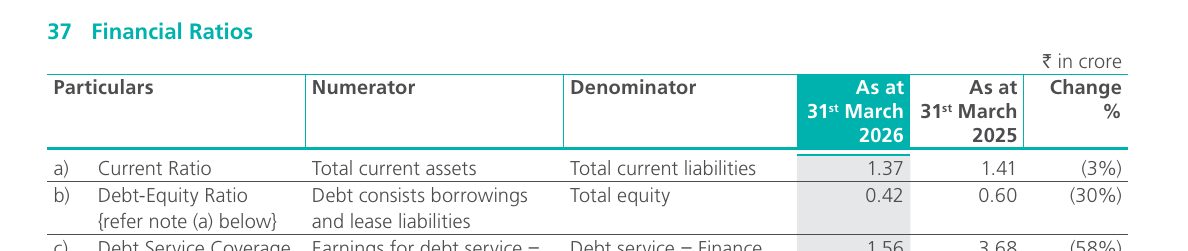
- Debt-to-equity fell to 0.42 from 0.60, a 30% drop: 42 paise of debt for every rupee of equity.
- Debt here means borrowings plus lease liabilities, divided by total equity.
Don't mix it up
the usual confusions
Debt-to-equity ratio ≠ total liabilities
Total liabilities include money owed to suppliers and other bills. Debt means borrowed money that carries interest: only the ₹20 crore loan for Sameer Chai.
Debt-to-equity ratio ≠ net debt
Net debt subtracts cash from debt. Sameer Chai has ₹55 crore of cash against a ₹20 crore loan, so its net debt is below zero.
Debt-to-equity ratio ≠ current ratio
The current ratio checks whether bills due this year can be paid. Debt-to-equity looks at how the whole business is funded.
Three quick sips
no sign-up, nothing saved
Hindi mein
डेट-टू-इक्विटी रेशियो
डेट-टू-इक्विटी रेशियो बताता है कि मालिकों के लगाए हर ₹1 पर कंपनी ने कितना क़र्ज़ ले रखा है।