ROE (return on equity) meaning in simple words, with example
ROE: the year's profit as a percentage of the owners' money in the business: how hard the shareholders' rupees are working.

The story
two people, one chai stall
Sameer is pleased with himself. ₹9 crore of profit, a record. Riya slides a calculator across the table.
 Riya
Good number. Now, how much of the owners' money did it take?
 Sameer
Owners' money?
RiyaNet worth. ₹50 crore of share capital plus ₹60 crore of reserves: ₹110 crore. That's what shareholders have in the business.
SameerAnd ₹9 crore on ₹110 crore is...
RiyaAbout 8.2%. That's our ROE, return on equity.
SameerA bank fixed deposit pays not much less.
RiyaWhich is why investors frown at it. They take more risk than a depositor, so they want more than a deposit pays.
SameerThen how do we push it up?
RiyaMake more profit with the same money. Most of the IPO cash still sits in the bank, and our books show no income from it. Turn it into busy stalls and the ROE climbs.
SameerOr borrow lots and shrink equity?
RiyaThat also lifts ROE. It just lifts the risk with it.
The grown-up version
same idea, exact words
Return on equity is profit after tax (less any preference dividend) divided by shareholders' equity. The ICAI Guidance Note on Schedule III suggests using average equity for the year, and most companies follow it, so the published figure can differ a little from a simple year-end calculation. A high ROE can come from a strong business or from heavy borrowing, which shrinks equity, so it is usually read alongside the debt-to-equity ratio.
Formula
ROE = Profit after tax ÷ Average shareholders' equity × 100
Which rule asks for itSchedule III to the Companies Act, 2013 (Division II, Part I, Additional Regulatory Information, item (xiv)), inserted by MCA notification G.S.R. 207(E) of 24 March 2021: companies must disclose ROE among 11 ratios, show what goes into the numerator and denominator, and explain any change of more than 25% from the previous year.
Spot it in the wild
a real annual report, a real page
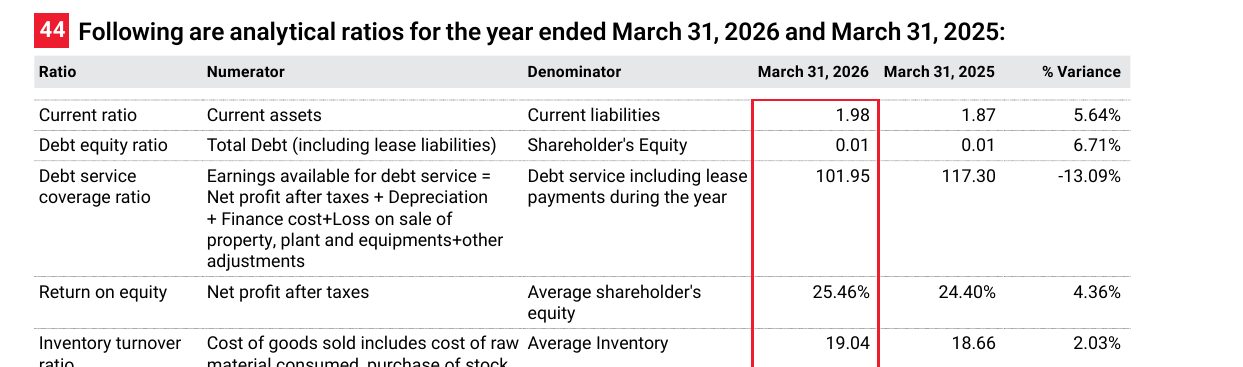
- ROE: 25.46%, up from 24.40%. About ₹25 of profit for every ₹100 of shareholders' money.
- The recipe: profit after tax, divided by the shareholders' equity averaged over the year.
Don't mix it up
the usual confusions
ROE ≠ ROCE
ROCE (return on capital employed) counts borrowed money too, and uses profit before interest and tax. ROE looks only at the owners' money and the profit left for them.
ROE ≠ net profit margin
Margin compares profit with sales: Sameer Chai earns ₹9 crore on ₹120 crore of sales, 7.5%. ROE compares the same profit with the owners' money: about 8.2%.
ROE ≠ dividend yield
Dividend yield is cash paid out compared with the share price. ROE is profit earned compared with the money in the books, paid out or not.
Three quick sips
no sign-up, nothing saved
Hindi mein
आरओई (रिटर्न ऑन इक्विटी)
आरओई बताता है कि मालिकों के लगाए हर ₹100 पर कंपनी ने साल में कितना मुनाफ़ा कमाया।