
P/E ratio meaning in simple words: price compared with profit
P/E ratio: the share price divided by the profit per share: how many rupees buyers pay today for each rupee the company earns in a year.

The story
two people, one chai stall
A stock-tips channel calls Sameer Chai "too costly at a P/E of 30". Sameer looks hurt.
 Sameer
Costly? Our share is only ₹54.
 Riya
P/E doesn't care about the price alone. It compares the price with the profit behind each share.
SameerWhich is?
Riya₹9 crore of profit over 5 crore shares. That's ₹1.80 a share. ₹54 divided by ₹1.80 is 30.
SameerSo people pay ₹30 for every ₹1 we earn in a year?
RiyaExactly. Another way to see it: at today's profit, it would take 30 years of earnings to add up to the price.
SameerThat sounds like a lot of patience.
RiyaIt means buyers expect the profit to grow. If we open more stalls and profit doubles, the same ₹54 price is a P/E of 15.
SameerAnd if profit falls?
RiyaThen 30 starts to look expensive, and the price usually falls to match.
The grown-up version
same idea, exact words
The price-to-earnings (P/E) ratio is the market price of a share divided by its earnings per share (EPS), usually basic EPS for the latest twelve months or financial year. A trailing P/E uses reported earnings; a forward P/E uses forecasts. It is a market measure, not an accounting one, so it changes every time the price moves, and it means little when earnings are very small or negative.
Formula
P/E = Market price per share ÷ Earnings per share
Which rule asks for itNo law defines or caps it. EPS, its input, is calculated under Ind AS 33 (Earnings per Share). In an IPO, the SEBI (ICDR) Regulations, 2018 require the 'Basis for Issue Price' section of the offer document to show the issuer's P/E at the issue price and the industry P/E (Schedule VI, Part A, item (9)(K)).
Spot it in the wild
a real annual report, a real page
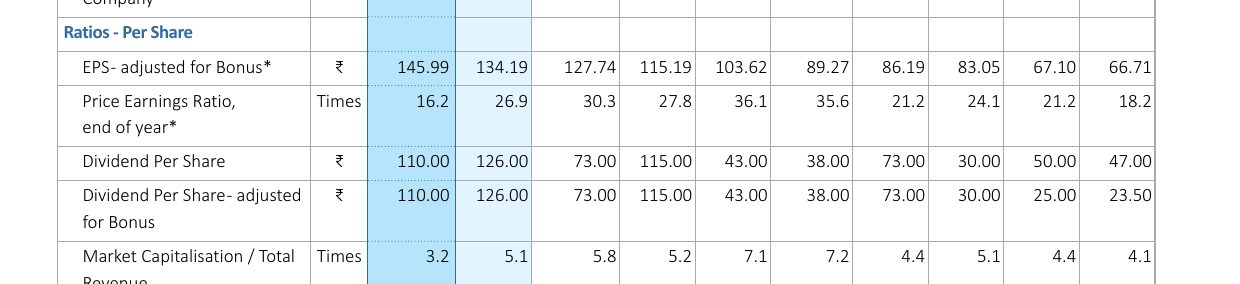
- P/E at the year end: 16.2 times, down from 26.9 a year earlier.
- The E in P/E: ₹145.99 of profit per share. The price was about 16 times this.
Don't mix it up
the usual confusions
P/E ratio ≠ EPS
EPS is the profit per share: ₹1.80 for Sameer Chai. P/E compares the share price with it: ₹54 ÷ ₹1.80 = 30.
P/E ratio ≠ P/B ratio
P/B compares the price with book value per share (what the books say each share owns). Sameer Chai: ₹54 ÷ ₹22, about 2.5.
P/E ratio ≠ cheap share
A low share price isn't a low P/E. A ₹54 share can be pricier, compared with its profit, than a ₹5,000 one.
Three quick sips
no sign-up, nothing saved
Hindi mein

पी/ई रेशियो (प्राइस-टू-अर्निंग्स)
पी/ई रेशियो शेयर के भाव को प्रति शेयर मुनाफ़े से भाग देकर निकलता है: कंपनी की एक साल की हर ₹1 कमाई के लिए ख़रीदार आज कितने रुपये दे रहे हैं।