
Book value per share meaning in simple words, and P/B ratio
Book value: the owners' share of the company as the accounts record it, net worth, and book value per share is that amount divided by the number of shares.

The story
two people, one chai stall
On an investor call, a fund manager remarks that the shares trade at 2.5 times book. Sameer nods wisely, then mutes and turns to Riya.
 Sameer
What book?
 Riya
Our account books. Book value is what the balance sheet says belongs to shareholders: ₹50 crore of capital plus ₹60 crore of reserves.
Sameer₹110 crore. Per share?
Riya₹110 crore over 5 crore shares is ₹22. So the books say each share owns ₹22 of the business.
SameerBut people pay ₹54.
RiyaRight. ₹54 divided by ₹22 is about 2.5. That's the "2.5 times book" they meant, the price-to-book ratio.
SameerWhy pay more than the books say?
RiyaThe books record kettles and cash at cost. They don't put a value on the queue outside every stall. Buyers are paying for future profits.
SameerAnd if the price fell below ₹22?
RiyaThen the market would be saying the business is worth less than its own accounts. That's usually a worry, sometimes a bargain.
The grown-up version
same idea, exact words
Book value is the carrying amount of shareholders' equity: total assets minus total liabilities as shown in the balance sheet. Book value per share divides it by the number of equity shares outstanding. It reflects historical cost and accounting choices, not the price the assets would fetch, and it leaves out things the books don't record, such as a brand built in-house. In IPO documents it appears as net asset value (NAV) per share.
Formula
Book value per share = Net worth ÷ Number of shares. P/B = Share price ÷ Book value per share
Which rule asks for itNet worth is defined in Section 2(57), Companies Act, 2013 (paid-up capital plus reserves from profits and securities premium, less accumulated losses; revaluation reserves excluded). In an IPO, the SEBI (ICDR) Regulations, 2018 require NAV per share before and after the issue in the 'Basis for Issue Price' section (Schedule VI, Part A, item (9)(K)).
Spot it in the wild
a real annual report, a real page
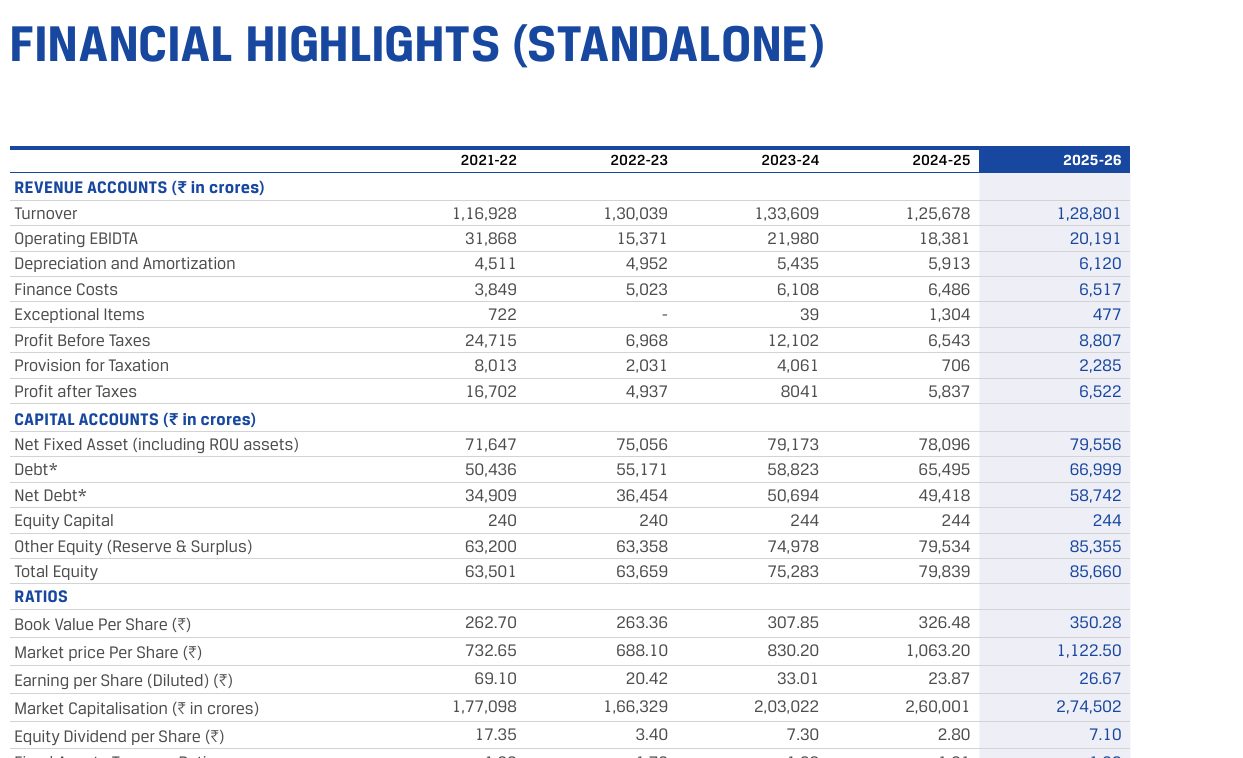
- Book value per share: ₹350.28 at 31 March 2026.
- The market price was ₹1,122.50, about 3.2 times the book value.
Don't mix it up
the usual confusions
Book value ≠ face value
Face value is the fixed ₹10 on each share. Book value adds the reserves too, so it's ₹22 for Sameer Chai.
Book value ≠ market price
The market price is what buyers pay today: ₹54. Book value is what the accounts say each share owns: ₹22. The gap is the market's bet on future profits.
Book value ≠ market cap
Market cap is price × shares: ₹270 crore. Its book-value twin is net worth: ₹110 crore.
Three quick sips
no sign-up, nothing saved
Hindi mein

बुक वैल्यू
बुक वैल्यू वह रक़म है जो कंपनी के खाते मालिकों की मानते हैं, यानी नेट वर्थ; इसे कुल शेयरों से भाग दें तो प्रति शेयर बुक वैल्यू मिलती है।