Face value of a share meaning in simple words, with example
Face value: the fixed, on-paper amount of one share, set in the company's charter, such as ₹10; it has nothing to do with what the share trades for.

The story
two people, one chai stall
Sameer is reading his own IPO prospectus from 2023. He frowns at the cover.
 Sameer
It says "face value ₹10". But people paid ₹40 for these, and today they're ₹54. Did someone make a typo?
 Riya
No typo. ₹10 is the face value. It's the fixed amount each share stands for in our charter.
SameerSo it's not what the share is worth?
RiyaNot at all. It's an accounting label. 5 crore shares times ₹10 gives our ₹50 crore of share capital.
SameerThen where did the rest of the IPO money go?
RiyaEach new share sold at ₹40. ₹10 went to share capital and ₹30 to the securities premium. On 1.5 crore shares, that premium was ₹45 crore.
SameerAnd when we announce a "5% dividend"?
RiyaThat's 5% of face value. Fifty paise a share, not 5% of ₹54.
SameerSo the smallest number on the cover is the one that never changes.
RiyaUnless we split the shares. Then it does.
The grown-up version
same idea, exact words
Face value (also called par value or nominal value) is the amount per share stated in the capital clause of the memorandum of association. Share capital in the balance sheet is the number of issued shares multiplied by face value; any amount received above it goes to the securities premium account. Shares generally cannot be issued below face value, except as the Act allows (for example, sweat equity). A stock split or consolidation changes face value.
Formula
Share capital = Number of shares × Face value. Securities premium = (Issue price − Face value) × Shares issued
Which rule asks for itSection 4(1)(e)(i) (memorandum states share capital divided into shares of a fixed amount), Section 52 (securities premium) and Section 53 (no issue at a discount), Companies Act, 2013; Schedule III requires the par value per share in the share capital note. In an IPO, Regulation 27 of the SEBI (ICDR) Regulations, 2018 requires face value to be shown next to the issue price in the same font size.
Spot it in the wild
a real annual report, a real page
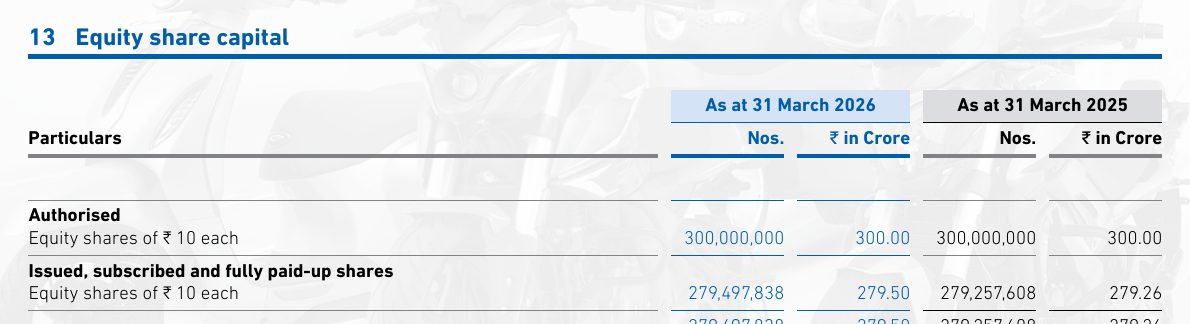
- Authorised: up to 30 crore shares of ₹10 face value each, ₹300 crore in all.
- Actually issued: about 27.95 crore shares × ₹10 = ₹279.50 crore of share capital.
Don't mix it up
the usual confusions
Face value ≠ market price
Face value stays at ₹10 on paper. The market price is whatever buyers pay today: ₹54 for Sameer Chai.
Face value ≠ book value
Book value per share is all the owners' money in the books divided by the shares: ₹22 for Sameer Chai. Face value is only the ₹10 share capital part.
Face value ≠ dividend percentage
A '5% dividend' means 5% of face value. On ₹10, that's ₹0.50 a share, not 5% of the ₹54 price.
Three quick sips
no sign-up, nothing saved
Hindi mein
फ़ेस वैल्यू (अंकित मूल्य)
फ़ेस वैल्यू शेयर की काग़ज़ पर तय क़ीमत है, जैसे ₹10; बाज़ार में शेयर किस भाव पर बिकता है, उससे इसका कोई लेना-देना नहीं।
Sources
- Amendment to Schedule III to the Companies Act, 2013 (G.S.R. 207(E), 24 March 2021), Ministry of Corporate Affairs
- Guidance Note on Division II, Ind AS Schedule III to the Companies Act, 2013 (Revised January 2022), ICAI
- SEBI (Issue of Capital and Disclosure Requirements) Regulations, 2018 (amended up to 21 March 2026), SEBI