Share capital meaning in simple words: authorised vs paid-up
Share capital: the face value of all the shares a company has issued: the number of shares multiplied by the face value of each.

The story
two people, one chai stall
Riya is filling in the share capital note. Sameer reads over her shoulder.
 Sameer
Share capital ₹50 crore? We raised ₹60 crore in the IPO alone.
 Riya
Share capital only counts the face value. Every share has a face value of ₹10, and we have 5 crore shares. 5 crore times ₹10 is ₹50 crore.
SameerBut people paid ₹40 a share.
RiyaRight. Of each ₹40, ₹10 is face value and goes into share capital. The other ₹30 is a premium and goes into a separate account, the securities premium.
SameerSo the IPO added how much to share capital?
Riya1.5 crore new shares times ₹10: ₹15 crore. The other ₹45 crore sits in reserves. Before the IPO, your 3 crore shares and the early investor's half crore made ₹35 crore.
SameerAnd ₹35 plus ₹15 is ₹50. Neat.
RiyaThe note also shows authorised capital: the most our memorandum lets us issue. We can raise it with a shareholder vote if we ever need to.
The grown-up version
same idea, exact words
Share capital is the capital raised by issuing shares, stated at face (par) value. Authorised capital is the maximum share capital allowed by the memorandum; issued, subscribed and paid-up capital is what has actually been issued and paid for. Any amount received above face value goes to the securities premium account under Section 52, not to share capital. Under Ind AS it is shown as 'Equity share capital' within equity, and a company can raise its authorised capital under Section 61.
Formula
Share capital = Number of shares issued × Face value per share
Which rule asks for itSections 2(8) (authorised capital), 2(64) (paid-up share capital), 43, 52 and 61, Companies Act, 2013; Schedule III (Division II).
Spot it in the wild
a real annual report, a real page
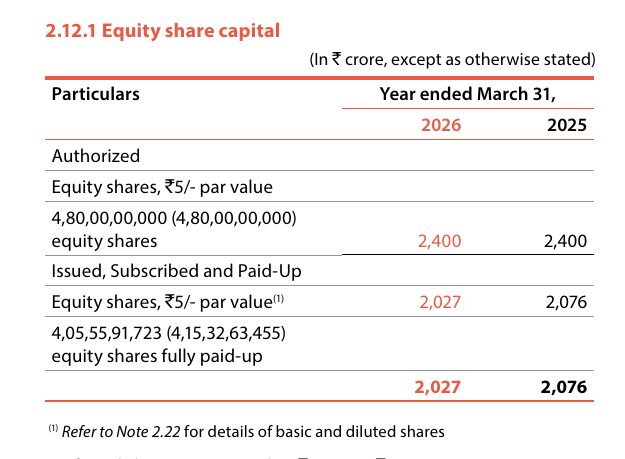
- Authorised: up to 480 crore shares of ₹5, or ₹2,400 crore. The ceiling, not what was issued.
- Actually issued: 405.56 crore shares of ₹5 = ₹2,027 crore, down from ₹2,076 crore.
Don't mix it up
the usual confusions
Share capital ≠ money raised in the IPO
Sameer Chai raised ₹60 crore, but only ₹15 crore (the face value part) became share capital. The other ₹45 crore went to the securities premium.
Share capital ≠ authorised capital
Authorised capital is the upper limit in the company's memorandum. Paid-up capital is what has actually been issued. They are often different.
Share capital ≠ net worth
Share capital is just one part of net worth. Add the reserves: ₹50 crore + ₹60 crore = ₹110 crore.
Three quick sips
no sign-up, nothing saved
Hindi mein
शेयर कैपिटल (अंश पूंजी)
शेयर कैपिटल कंपनी के जारी किए गए सभी शेयरों की फ़ेस वैल्यू का जोड़ है: शेयरों की संख्या गुणा हर शेयर की फ़ेस वैल्यू।
Sources
- Companies Act, 2013, India Code