IPO meaning in simple words: when a company first sells shares
IPO: (initial public offering) is the first time a company sells its shares to the public, so that anyone can then buy and sell them on a stock exchange.

The story
two people, one chai stall
October 2023. The night before Sameer Chai's IPO opens, Sameer can't sit still.
 Sameer
From tomorrow, strangers can own a piece of my chai company. Why does that feel so odd?
 Riya
Because it's an IPO, an initial public offering. It's the first time the public can buy our shares. The price is ₹40 each.
SameerAnd all the money comes to us?
RiyaNot all of it. We're selling 1.5 crore new shares. That's ₹60 crore for the company. That part is called the fresh issue.
SameerAnd the rest?
RiyaOur early investor is selling his 50 lakh shares too. That's ₹20 crore, and it goes to him, not to us. So the whole issue is ₹80 crore.
SameerDo I lose control?
RiyaNo. You keep your 3 crore shares. After the IPO there are 5 crore shares, so you own 60% and the public owns 40%.
SameerAnd then?
RiyaA few days after bidding closes, the shares are listed. From then on, anyone can buy or sell them on the exchange, every trading day.
The grown-up version
same idea, exact words
An initial public offer is a company's first offer of shares to the public, after which the shares are listed on a stock exchange. It can combine a fresh issue, where new shares are issued and the money goes to the company, with an offer for sale, where existing shareholders sell and keep the proceeds. The issuer first files a draft offer document with SEBI and the stock exchanges, and must meet SEBI's eligibility tests, such as a track record of profits and net worth, or else allot at least 75% of the net offer to qualified institutional buyers. Promoters must hold at least 20% of the post-issue capital, which is locked in, usually for 18 months.
Formula
Issue size = Fresh issue + Offer for sale
Which rule asks for itChapter II (initial public offer on main board), SEBI (ICDR) Regulations, 2018; Sections 23 and 26, Companies Act, 2013.
Spot it in the wild
a real annual report, a real page
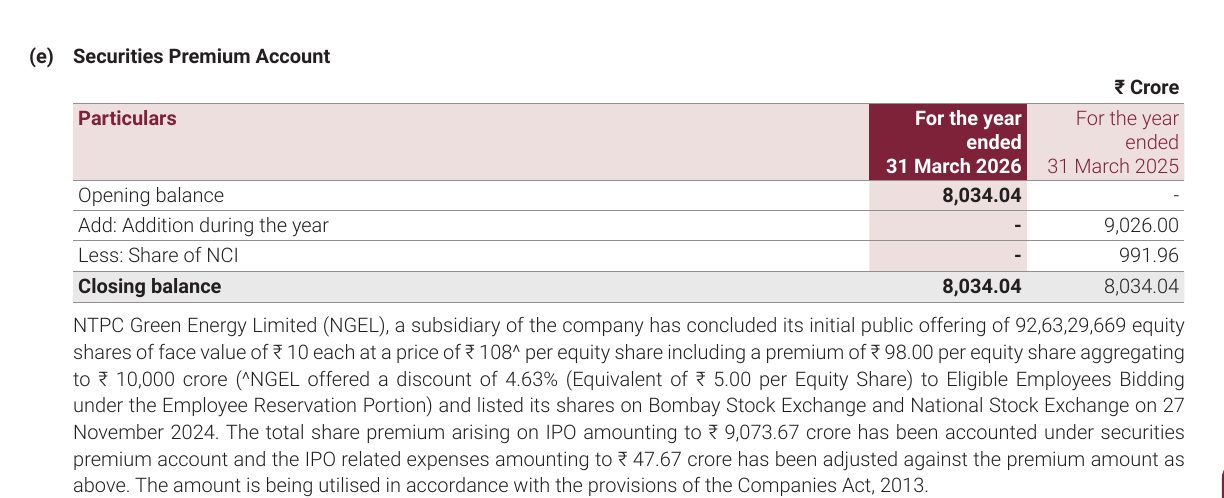
- NTPC Green Energy's IPO: about 92.6 crore new shares at ₹108 each, raising ₹10,000 crore.
- After the IPO, the shares were listed on BSE and NSE on 27 November 2024.
Don't mix it up
the usual confusions
IPO ≠ DRHP
The DRHP is the draft document filed with SEBI months before the IPO. The IPO is the sale itself.
IPO ≠ offer for sale
An offer for sale is the part of an IPO where existing owners sell their shares. That money goes to them, not to the company.
IPO ≠ FPO (further public offer)
An FPO is when a company that is already listed sells more shares to the public. An IPO is only the first time.
Three quick sips
no sign-up, nothing saved
Hindi mein
आईपीओ (IPO)
IPO वह मौक़ा है जब कोई कंपनी पहली बार अपने शेयर आम लोगों को बेचती है, ताकि बाद में कोई भी उन्हें स्टॉक एक्सचेंज पर ख़रीद-बेच सके।