
Going concern meaning in simple words: will the firm last a year?
Going concern: the accounts assume the company will keep running for the foreseeable future, at least the next year, rather than shutting down or selling up.

The story
two people, one chai stall
The auditors book a meeting titled "Going concern". Sameer assumes the worst.
 Sameer
Going concern? Are they saying we're going under?
 Riya
Relax. They ask every company this: will the business still be running for at least the next year? Our accounts assume it will. That's the going-concern basis.
SameerAnd if it won't be?
RiyaThen the accounts would be drawn up differently, closer to what our kiosks would fetch in a sale. So auditors look for warning signs: loans due with no way to repay, cash running out, losses year after year, a key person or big customer gone.
SameerDo we have any?
RiyaWe have ₹55 crore in the bank, ₹15 crore of bills due within a year, and a ₹20 crore loan. Our operations brought in ₹14 crore of cash last year.
SameerAnd the GST fight?
Riya₹1.2 crore. Even if we lose, our cash covers it many times over.
SameerSo they're not worried.
RiyaNot at all. And the board's report will say, as it does every year, that we prepared the accounts as a going concern.
The grown-up version
same idea, exact words
Going concern is the assumption that an entity will continue in operation for the foreseeable future, with neither the intention nor the need to liquidate or stop trading. Under Ind AS 1, management assesses this using at least the twelve months from the end of the reporting period, and discloses any material uncertainties. Under SA 570 (Revised), the auditor evaluates that assessment: an adequately disclosed material uncertainty leads to an unmodified opinion with a separate 'Material Uncertainty Related to Going Concern' section; inadequate disclosure leads to a qualified or adverse opinion; and an inappropriate use of the going-concern basis leads to an adverse opinion. The directors' responsibility statement in the Board's report confirms the accounts were prepared on a going-concern basis.
Which rule asks for itInd AS 1, paragraphs 25–26; SA 570 (Revised); Section 134(5)(d), Companies Act, 2013; CARO 2020, clause 3(xix).
Spot it in the wild
a real annual report, a real page
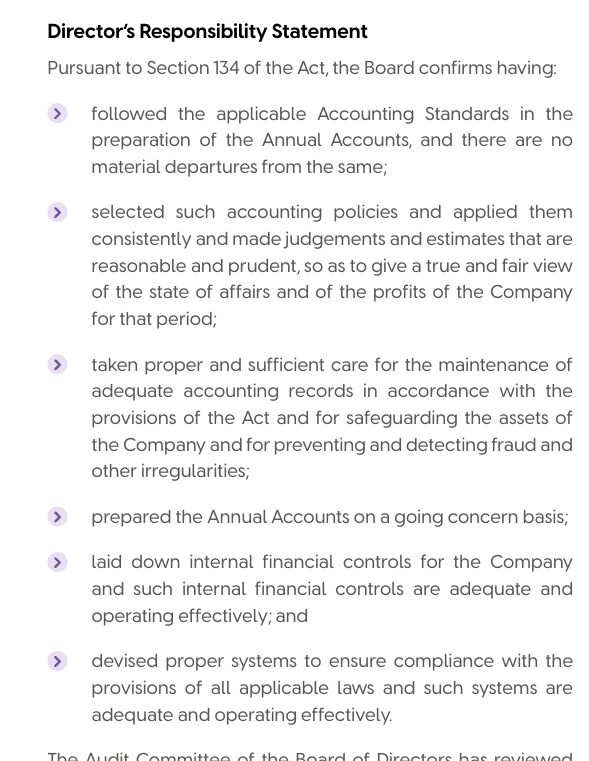
- The directors confirm the accounts assume the business carries on as normal.
- It's part of the directors' responsibility statement, which the Board's report carries under Section 134.
Don't mix it up
the usual confusions
Going concern ≠ profitable
A loss-making company can still be a going concern if it has cash or funding. A profitable one can be in doubt if a big loan falls due and it can't pay.
Going concern ≠ insolvency
Insolvency is a legal process once a company can't pay its debts. Going-concern doubt is an early warning in the accounts, often long before that.
Going concern ≠ qualified opinion
A going-concern warning that is properly disclosed leaves the opinion clean, with an extra section. A qualified opinion means the auditor disagrees with something.
Three quick sips
no sign-up, nothing saved
Hindi mein

गोइंग कंसर्न
गोइंग कंसर्न का मतलब है कि खाते यह मानकर बनते हैं कि कंपनी आगे भी, कम से कम अगले एक साल, चलती रहेगी, बंद या बिकने वाली नहीं है।