
Pledged shares meaning in simple words: shares as loan security
Pledged shares: shares an owner, often the promoter, has handed to a lender as security for a loan; if the loan goes bad, the lender can sell them.

The story
two people, one chai stall
Sameer needs a personal loan, and he doesn't want to sell a single share.
 Sameer
The bank will lend against my shares. I keep them, it just holds them as security. Easy, no?
 Riya
That's a pledge. You'd pledge 30 lakh shares, 10% of your holding. At ₹54, that's ₹16.2 crore of shares.
SameerAnd the bank lends me less than that?
RiyaYes, it keeps a cushion. If our price falls a lot, it can ask you for more shares or cash. If you can't give it, it can sell the pledged shares.
SameerSell them? On the market?
RiyaOn the market, sometimes all at once. That can push the price down further, which worries every other shareholder.
SameerSo people will know?
RiyaYes. Promoter pledges are disclosed, and they show up in our shareholding pattern every quarter. Investors watch that number closely.
Sameer10% sounds small.
RiyaIt is. The worry starts when a promoter pledges most of what he owns.
The grown-up version
same idea, exact words
A pledge is a form of encumbrance: shares are given to a lender as security, usually through the depository system, and stay in the owner's name unless the lender invokes the pledge and sells them. Under SEBI's takeover regulations, a promoter must disclose any encumbrance, and any invocation or release, within seven working days, though since April 2022 this separate filing isn't needed where the encumbrance is created in a depository. Promoters also declare each year that there are no other encumbrances. Listed companies show pledged promoter shares in their quarterly shareholding pattern.
Which rule asks for itRegulations 28(3) and 31, SEBI (SAST) Regulations, 2011; Regulation 31, SEBI (LODR) Regulations, 2015.
Spot it in the wild
a real annual report, a real page
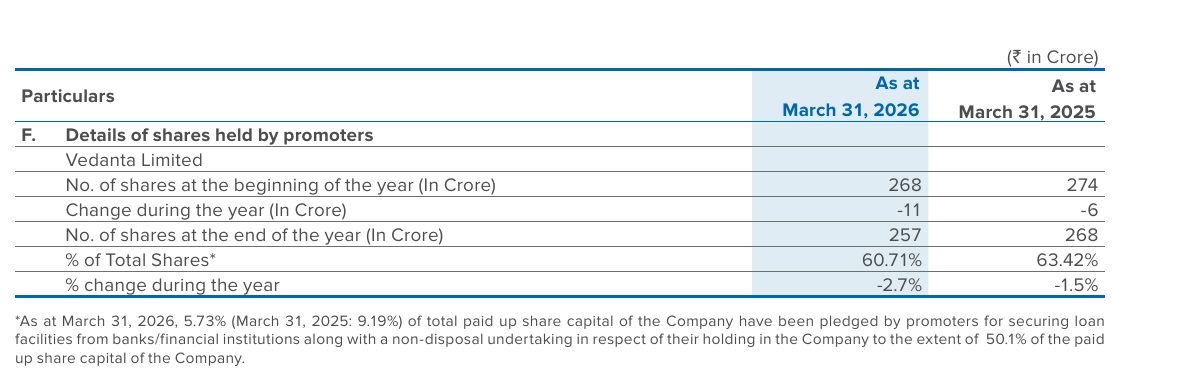
- Vedanta, the promoter, held 60.71% of Hindustan Zinc on 31 March 2026.
- Shares equal to 5.73% of the company were pledged by the promoter to secure loans, down from 9.19%.
Don't mix it up
the usual confusions
Pledged shares ≠ selling shares
Pledged shares still belong to the promoter, with the votes and dividends. They change hands only if the lender invokes the pledge.
Pledged shares ≠ non-disposal undertaking
A non-disposal undertaking is a promise to a lender not to sell, without handing the shares over. SEBI counts it as an encumbrance too.
Pledged shares ≠ assets pledged by the company
Companies also pledge stock, deposits or shares in subsidiaries for their own loans. A promoter pledge is the owner borrowing against his own shares.
Three quick sips
no sign-up, nothing saved
Hindi mein
गिरवी रखे शेयर (प्लेज्ड शेयर्स)
प्लेज्ड शेयर वे शेयर हैं जो मालिक, अक्सर प्रमोटर, लोन की ज़मानत के तौर पर लेंडर के पास गिरवी रखता है; लोन न चुकने पर लेंडर उन्हें बेच सकता है।