
Statutory audit meaning in simple words: who checks the books
Statutory audit: the yearly check of a company's accounts by an outside chartered accountant, which the law requires, to say whether the numbers are fair.
The story
two people, one chai stall
April 2026. Strangers with laptops have taken over the meeting room.
 Sameer
Who are these people, and why are they counting our kettles?
 Riya
Our statutory auditors, a chartered accountant firm the shareholders appointed. The law says an outside auditor must check our accounts every year.
SameerWe already checked them. ₹120 crore of sales, ₹9 crore of profit.
RiyaThat's the point. We wrote those numbers. They test them: bank statements, supplier bills, a sample of stall sales, and whether ₹145 crore of assets really exists.
SameerHence the kettle census.
RiyaExactly. Then they sign a report saying whether our accounts give a "true and fair view". This year it's clean, with no reservations.
SameerCan we hire a friendlier firm next year?
RiyaNo. Shareholders appoint them for five years, and removing them early needs a special resolution and government approval. And as a listed company, we can keep one firm for two terms at most. Then we have to change.
The grown-up version
same idea, exact words
A statutory audit is the independent audit of a company's financial statements that the Companies Act requires every year. Shareholders appoint the auditor, a chartered accountant or a firm, at an AGM, to hold office until the end of the sixth AGM after that one: in effect, five years. A listed company may appoint an individual for at most one five-year term and a firm for at most two, followed by a five-year gap. The auditor reports to the members on whether the financial statements give a true and fair view, following the Standards on Auditing. The Corporate Laws (Amendment) Bill, 2026 proposes letting prescribed classes of companies skip appointing an auditor; as of November 2026 it is not law.
Which rule asks for itSections 139 to 143, Companies Act, 2013; Standards on Auditing under Section 143(10).
Spot it in the wild
a real annual report, a real page
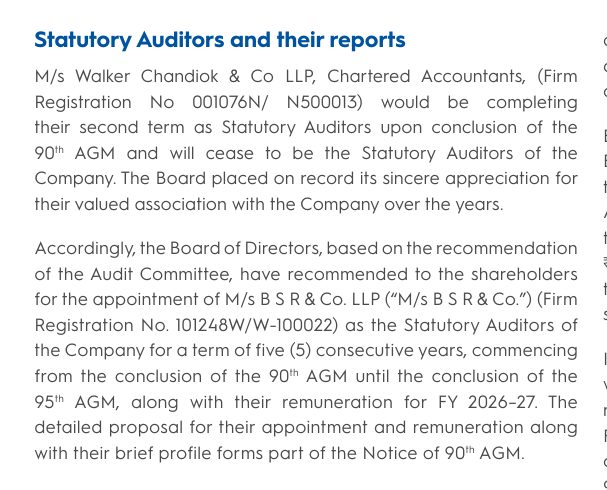
- The old audit firm has served two five-year terms, the most a listed company allows, so it must step down.
- A new firm is proposed for five years, from the 90th AGM to the 95th. Shareholders vote on it.
Don't mix it up
the usual confusions
Statutory audit ≠ internal audit
Internal auditors work for management and the audit committee, checking processes through the year. The statutory auditor is outside, reports to shareholders and signs an opinion on the accounts.
Statutory audit ≠ secretarial audit
A secretarial audit, by a company secretary, checks whether the company followed company and securities law. The statutory audit checks the numbers.
Statutory audit ≠ tax audit
A tax audit is a separate check under income-tax law, for the tax department. The statutory audit is under the Companies Act, for shareholders.
Three quick sips
no sign-up, nothing saved
Hindi mein

वैधानिक ऑडिट (स्टैच्यूटरी ऑडिट)
स्टैच्यूटरी ऑडिट वह सालाना जाँच है जिसमें बाहर का चार्टर्ड अकाउंटेंट कंपनी के खातों को परखता है और बताता है कि आँकड़े सही और निष्पक्ष हैं या नहीं।
Sources
- Companies Act, 2013, India Code
- JPC report summary, Corporate Laws (Amendment) Bill, 2026, PRS Legislative Research