
CARO meaning in simple words: the auditor's extra checklist
CARO: a government order that makes a company's auditor answer a fixed list of extra questions, such as unpaid taxes and cash losses, in an annexure to the audit report.

The story
two people, one chai stall
The auditors hand Riya a draft report with a long annexure stapled to the back.
 Sameer
What's this extra bit? Twenty-one questions?
 Riya
That's CARO, the Companies (Auditor's Report) Order. On top of their opinion, the auditors answer a fixed list of questions about us.
SameerSuch as?
RiyaDo our kiosks and vans really exist? Have we paid GST, PF and income tax on time? Did we make a cash loss? Can we pay the bills falling due within a year?
SameerEasy. Yes, yes, no, yes.
RiyaMostly. But remember the ₹1.2 crore GST notice we're fighting?
SameerI try not to.
RiyaWe haven't paid it, because we dispute it. CARO makes them list dues like that: the amount and where the case is pending. So it appears there in black and white.
SameerDoes our premix company get the questions too?
RiyaYes. Sameer Chai Foods is private, but it's our subsidiary, so the small-company exemptions don't cover it.
The grown-up version
same idea, exact words
The Companies (Auditor's Report) Order, 2020 (CARO 2020) is made by the Central Government under Section 143(11), in consultation with the National Financial Reporting Authority. It requires the statutory auditor to report on 21 matters in paragraph 3, including fixed assets, inventory, loans given, statutory dues, defaults on borrowings, use of funds raised, fraud, cash losses, the ability to meet liabilities due within a year, and unspent CSR. Clause 3(vii)(b) requires the auditor to list statutory dues not deposited because of a dispute, with the amount and the forum where the dispute is pending. CARO applies to every company, including foreign companies, except banking and insurance companies, Section 8 companies, One Person Companies, small companies, and private companies that are not a holding or subsidiary of a public company and stay within set limits (capital and reserves up to ₹1 crore, bank borrowings up to ₹1 crore, revenue up to ₹10 crore). It does not apply to the report on consolidated accounts, except clause (xxi).
Which rule asks for itCompanies (Auditor's Report) Order, 2020, issued under Section 143(11), Companies Act, 2013.
Spot it in the wild
a real annual report, a real page
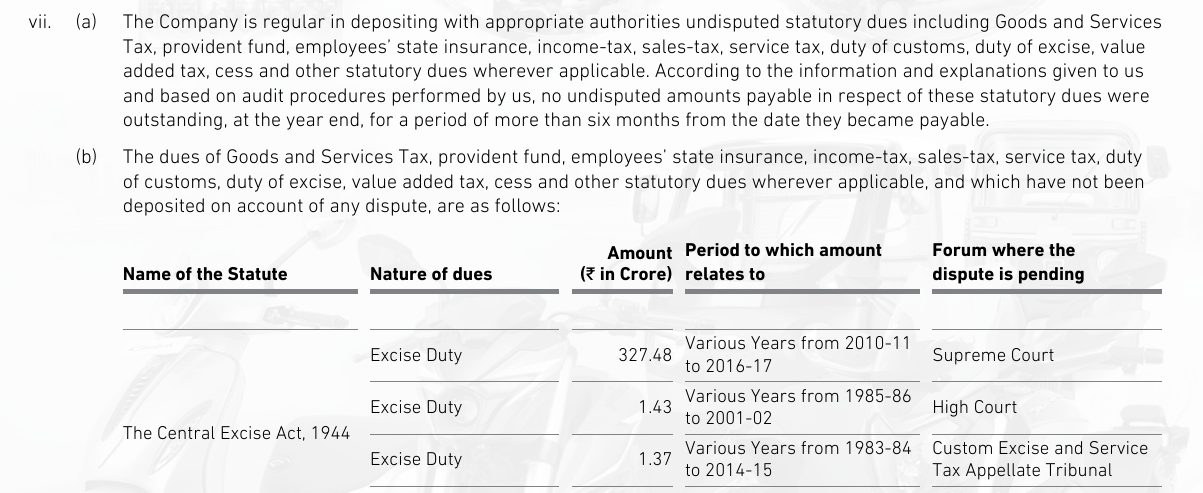
- CARO question vii(b): tax and other dues the company hasn't paid because it is fighting them.
- The biggest line: ₹327.48 crore of excise duty, under dispute in the Supreme Court.
Don't mix it up
the usual confusions
CARO ≠ auditor's report
The auditor's report gives the opinion on the accounts. CARO is an annexure to it: yes-or-no answers on specific matters.
CARO ≠ contingent liability
A contingent liability is a note in the accounts about a possible future cost. CARO's disputed-dues list is the auditor's own report on taxes not paid because of a dispute.
CARO ≠ internal financial controls report
That's a different annexure, on whether the company's controls over its accounts work. CARO covers a set list of matters, not controls in general.
Three quick sips
no sign-up, nothing saved
Hindi mein

CARO (कंपनीज़ ऑडिटर्स रिपोर्ट ऑर्डर)
CARO सरकार का वह आदेश है जिसके तहत ऑडिटर को अपनी रिपोर्ट के साथ कुछ तय सवालों के जवाब देने होते हैं, जैसे बकाया टैक्स और नकद घाटा।
Sources
- Companies (Auditor's Report) Order, 2020 (S.O. 849(E), 25 February 2020), Ministry of Corporate Affairs
- Companies Act, 2013, India Code