
Turnover meaning in simple words: sales, not profit
Turnover: the total money a company earns from selling its goods and services in a year, before any costs are taken off.
The story
two people, one chai stall
A bank's loan form has a box marked "Turnover". Sameer stares at it.
 Sameer
Turnover. Is that how fast we turn the chai over?
 Riya
Close. It's everything we sold in the year: chai, buns and office supply. ₹120 crore in FY26.
SameerNot ₹9 crore? That's what we made.
RiyaThat's profit, what's left after milk, staff, rent, interest and tax. Turnover is before any costs. Interest earned from a bank wouldn't count either; that's other income.
SameerWhy does everyone ask for it?
RiyaBecause the law uses it to sort companies by size. Small private companies, up to ₹100 crore of turnover, get lighter paperwork. At ₹1,000 crore, CSR kicks in.
SameerWe're at ₹120 crore. So no CSR for us?
RiyaWe still do CSR, because our profit crossed ₹5 crore. Any one test is enough.
SameerSo the bank wants the big number.
RiyaIt wants both. Turnover shows how big we are; profit shows how well we run.
The grown-up version
same idea, exact words
Section 2(91) of the Companies Act, 2013, as substituted in 2018, defines turnover as the gross amount of revenue recognised in the profit and loss account from the sale, supply or distribution of goods, or from services rendered, during a financial year. Income that isn't from sales, such as interest earned, is not part of it. The Act uses turnover as a size test: CSR under Section 135 applies at ₹1,000 crore of turnover (or ₹500 crore of net worth, or ₹5 crore of net profit), and a private company can be a small company under Section 2(85) only if its turnover is within the prescribed limit, ₹100 crore since 1 December 2025. SEBI's related-party rules measure materiality against annual consolidated turnover.
Which rule asks for itSection 2(91), Companies Act, 2013 (substituted by the Companies (Amendment) Act, 2017); thresholds in Sections 135(1) and 2(85); Companies (Specification of Definitions Details) Rules, 2014, as amended on 1 December 2025.
Spot it in the wild
a real annual report, a real page
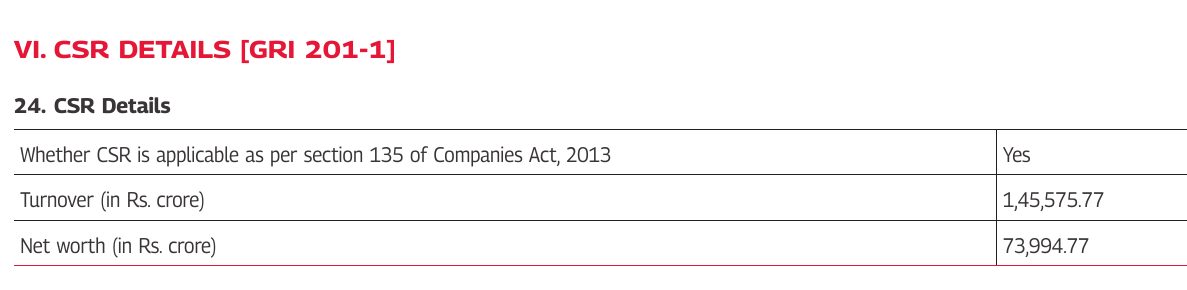
- CSR applies to Mahindra & Mahindra: the answer is a plain Yes.
- Its turnover: ₹1,45,575.77 crore, far above the ₹1,000 crore line that alone would make CSR apply.
Don't mix it up
the usual confusions
Turnover ≠ profit
Turnover is everything coming in from sales. Profit is what's left after costs and tax: ₹120 crore of turnover left Sameer Chai ₹9 crore of profit.
Turnover ≠ revenue
Often used for the same thing. 'Revenue from operations' in Ind AS accounts can also include other operating income, while turnover in the Act counts sales of goods and services.
Turnover ≠ employee turnover
In HR and BRSR tables, turnover means the share of staff who left during the year. It has nothing to do with sales.
Three quick sips
no sign-up, nothing saved
Hindi mein
टर्नओवर (कारोबार)
टर्नओवर वह कुल रक़म है जो कंपनी साल भर में अपना सामान और सेवाएँ बेचकर कमाती है, कोई ख़र्च घटाने से पहले।
Sources
- Companies Act, 2013, India Code
- Companies (Specification of definition details) Amendment Rules, 2025 (G.S.R. 880(E), 1 December 2025), Ministry of Corporate Affairs
- SEBI (LODR) Regulations, 2015, last amended on 15 October 2026, SEBI