
YoY (year-on-year) meaning in simple words: growth explained
YoY (year-on-year): comparing a number with the same number for the same period a year earlier, usually as a percentage change.

The story
two people, one chai stall
May. The Q4 results are on Sameer's desk, and he is already celebrating.
 Sameer
Q4 sales ₹33 crore, Q3 was ₹31 crore. Up 6.5%!
 Riya
That's QoQ, quarter-on-quarter. Fair, but quarters aren't alike. Exams, monsoon, wedding season: they all change how much chai people drink.
SameerSo how do investors know if we're really growing?
RiyaThey compare Q4 with Q4 last year. That's YoY, year-on-year. Same season, so it's a fair fight. That's why the results table has a column for the same quarter last year.
SameerAnd for the full year?
RiyaProfit before tax went from ₹10 crore to ₹12 crore. ₹2 crore more, divided by last year's ₹10 crore: up 20% YoY.
SameerLast year we also added ₹2 crore. Why did that look better?
RiyaBecause FY24 was only ₹8 crore. ₹2 crore on ₹8 crore is 25%. The base got bigger.
SameerSo to keep the same percentage, we have to grow more every year.
RiyaExactly. Growing up is hard, even for percentages.
The grown-up version
same idea, exact words
Year-on-year (YoY) growth compares a figure for a period with the same period a year earlier: a full year with the previous year, or a quarter with the same quarter of the previous year. It is expressed as a percentage change on the earlier figure. Comparing like periods removes seasonal swings, which a quarter-on-quarter (QoQ) comparison does not. SEBI's format for quarterly results requires listed companies to show the corresponding quarter of the previous year next to the current and preceding quarters.
Formula
YoY growth = (This period − Same period last year) ÷ Same period last year × 100
Which rule asks for itRegulation 33, SEBI (LODR) Regulations, 2015, read with the financial results format in SEBI's LODR Master Circular (updated 30 January 2026).
Spot it in the wild
a real annual report, a real page
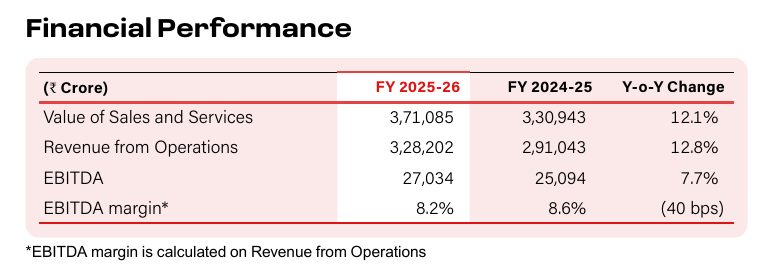
- Retail revenue of ₹3,28,202 crore against ₹2,91,043 crore last year: up 12.8% year-on-year.
- Not everything rose: the margin slipped from 8.6% to 8.2%, shown as (40 bps) in brackets.
Don't mix it up
the usual confusions
YoY (year-on-year) ≠ QoQ (quarter-on-quarter)
QoQ compares a quarter with the quarter just before it, like Q4 with Q3. YoY compares it with the same quarter last year, so seasons don't distort it.
YoY (year-on-year) ≠ CAGR
CAGR is the steady yearly rate over several years. Profit went from ₹8 crore to ₹12 crore in two years: YoY was 25% then 20%, but the CAGR is about 22.5%.
YoY (year-on-year) ≠ percentage points
When a margin falls from 8.6% to 8.2%, that's 0.4 percentage points (40 bps), not a 0.4% fall. Results tables use bps for changes in ratios.
Three quick sips
no sign-up, nothing saved
Hindi mein

सालाना बढ़त (YoY)
YoY का मतलब है किसी आँकड़े की तुलना पिछले साल के उसी समय के आँकड़े से करना, आमतौर पर प्रतिशत बढ़त या गिरावट के रूप में।