
Free float meaning in simple words: the shares the public holds
Free float: the part of a company's shares held by the public rather than its promoters, the shares that can actually change hands on the market.

The story
two people, one chai stall
A market news app shows Sameer Chai's "free float" as 40%. Sameer is puzzled.
 Sameer
Free float? Are we a boat now?
 Riya
Close. It's the part of the company that floats around the market. Shares held by the public, not by you.
SameerI hold 3 crore shares.
RiyaOut of 5 crore. That's 60% with you, the promoter. The other 2 crore shares, 40%, are with the public. At ₹54, that float is worth ₹108 crore.
SameerWhy does anyone care?
RiyaOnly floating shares can actually be bought. Index makers and big funds look at that, not the full ₹270 crore.
SameerWhat if I bought more and held, say, 80%?
RiyaYou couldn't keep it. The rules say every listed company must keep at least 25% with the public. Fall below and you get 12 months to fix it.
SameerSo the public's share is protected.
RiyaYes. A listed company can't become one person's private stall again.
The grown-up version
same idea, exact words
Free float is the portion of a listed company's shares available for trading, broadly the public shareholding. In Indian law the measurable concept is 'public shareholding': equity shares held by persons other than the promoter and promoter group and the company's subsidiaries and associates. Index providers calculate their own free float, which can also exclude other locked-in or strategic holdings, and use free-float market capitalisation to weight stocks in indices.
Formula
Free float % = Public shareholding ÷ Total shares × 100. Free-float market cap = Public shares × Share price
Which rule asks for itRule 19A, Securities Contracts (Regulation) Rules, 1957: every listed company must maintain public shareholding of at least 25%, and restore it within 12 months if it falls below. Rule 19(2)(b), recast in March 2026, sets the minimum offered to the public at listing and the timeline to reach 25%, with longer timelines for the largest issuers.
Spot it in the wild
a real annual report, a real page
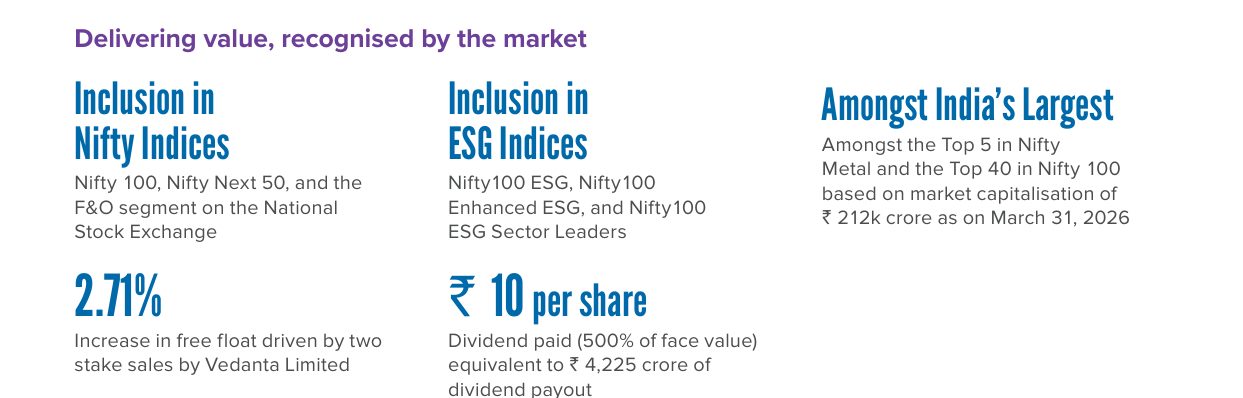
- Free float went up 2.71%, after two stake sales by Vedanta Limited.
- Market cap at 31 March 2026: about ₹2.12 lakh crore.
Don't mix it up
the usual confusions
Free float ≠ market cap
Market cap values all the shares: ₹270 crore for Sameer Chai. Free-float market cap values only the public's 2 crore shares: ₹108 crore.
Free float ≠ promoter holding
Promoter holding is the founders' and their group's share: 60% for Sameer. Free float is roughly everything else: 40%.
Free float ≠ trading volume
Free float is how many shares could trade. Volume is how many actually did on a given day.
Three quick sips
no sign-up, nothing saved
Hindi mein
फ़्री फ़्लोट
फ़्री फ़्लोट कंपनी के वे शेयर हैं जो प्रमोटरों के बजाय आम निवेशकों के पास हैं और बाज़ार में ख़रीदे-बेचे जा सकते हैं।