
Ind AS (Indian Accounting Standards) meaning in simple words
Ind AS: India's accounting standards, close to the global IFRS rules, that tell listed and large companies exactly how to count and show their numbers.

The story
two people, one chai stall
The auditors ask how the ordering app is being written off. Sameer turns to Riya.
 Sameer
Can't we just pick a method that makes profit look nice?
 Riya
No. We follow Ind AS, India's accounting rulebook. It's based on IFRS, the global one, with a few Indian tweaks.
SameerSince when?
RiyaSince we started the listing process. Any company that's listed, or getting listed, on the main board must use it. Small private firms can stay on the older rules.
SameerSo what does it say about the app?
RiyaInd AS 38 covers things you can't touch, like software. We built the app for ₹2.5 crore and spread it over five years, ₹0.5 crore a year.
SameerAnd Sameer Chai Foods? It's tiny.
RiyaIt's our subsidiary, so it uses Ind AS too. That's how its ₹0.5 crore profit adds cleanly to our ₹9 crore, making ₹9.5 crore for the group.
SameerOne rulebook for everyone.
RiyaWhich is why an investor can compare us with any other listed company.
The grown-up version
same idea, exact words
Indian Accounting Standards (Ind AS) are accounting standards converged with IFRS, notified by the Central Government under Section 133 of the Companies Act, 2013 through the Companies (Indian Accounting Standards) Rules, 2015. Rule 4 made them mandatory in phases: companies with net worth of ₹500 crore or more from 1 April 2016; all other companies whose equity or debt is listed or in the process of being listed (in India or abroad), and unlisted companies with net worth of ₹250 crore or more, from 1 April 2017; and in each phase, the holding, subsidiary, joint venture and associate companies of these. Companies listed only on an SME exchange are excluded. Once a company adopts Ind AS, it must keep using it, even if it later falls below the limits. Rule 5 left banks, insurers and NBFCs out of these phases; they are dealt with separately.
Which rule asks for itSection 133, Companies Act, 2013; Rule 4, Companies (Indian Accounting Standards) Rules, 2015, as amended.
Spot it in the wild
a real annual report, a real page
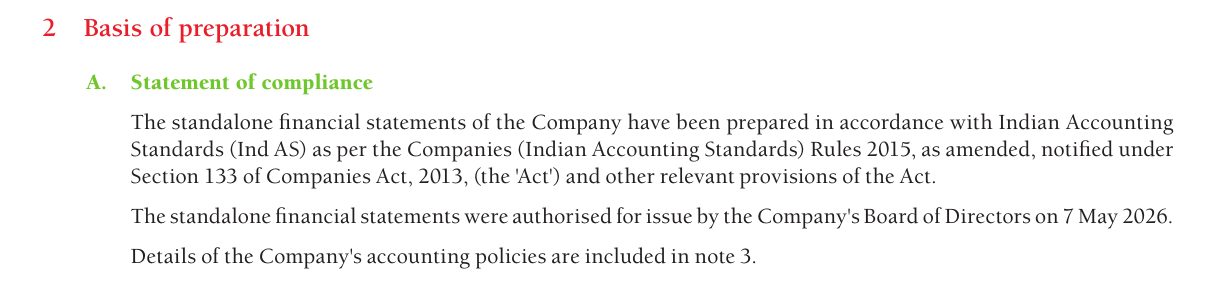
- Britannia says its accounts follow Ind AS, as laid down by the 2015 Ind AS Rules and Section 133 of the Companies Act.
Don't mix it up
the usual confusions
Ind AS ≠ IFRS
IFRS is the global standard used in many countries. Ind AS is India's version of it, mostly the same but with some Indian changes, called carve-outs.
Ind AS ≠ Indian GAAP (old AS)
The older Accounting Standards still apply to smaller unlisted companies. Ind AS uses more fair values and gives more detail.
Ind AS ≠ audit
Ind AS is the rulebook for preparing the accounts. An audit is the outside check that the accounts follow it.
Three quick sips
no sign-up, nothing saved
Hindi mein

भारतीय लेखा मानक (Ind AS)
Ind AS भारत के अकाउंटिंग नियम हैं, जो दुनिया के IFRS जैसे ही हैं, और लिस्टेड व बड़ी कंपनियों को बताते हैं कि अपने आँकड़े कैसे गिनें और दिखाएँ।
Sources
- Companies Act, 2013 (as amended), India Code
- Companies (Indian Accounting Standards) Rules, 2015 (G.S.R. 111(E), 16 February 2015), Ministry of Corporate Affairs