
Independent director meaning in simple words: the outside eye
Independent director: a board member with no business, family or job ties to the company or its owners, there to give an outside view and protect smaller shareholders.

The story
two people, one chai stall
Board meeting, May. The retired banker asks Sameer a sharp question about the new kiosks. Sameer whispers to Riya afterwards.
 Sameer
Whose side is she on?
 Riya
Nobody's. That's the point. She's an independent director. No big shareholding, no family ties, no job here.
SameerThen why is she on our board?
RiyaTo give an outside view and look after the small shareholders. You own 60% of the company. The other 40% need someone in the room who doesn't answer to you.
SameerHow many do we need?
RiyaThe Companies Act says at least a third: 2 of our 6. SEBI's rules say half if the chair isn't a non-executive, say if you chaired it. We have 3, so we're covered either way.
SameerAnd the scientist and the tax officer?
RiyaSame job. They also sit on the audit committee. Only they can approve deals like the milk from your sister's dairy.
SameerSo I hired people to question me.
RiyaYes. Investors like that.
The grown-up version
same idea, exact words
Under Section 149(6) of the Companies Act, 2013, an independent director is a director other than a managing director, whole-time director or nominee director who, in the Board's opinion, has integrity and relevant expertise, is not a promoter or related to one, and has no material financial relationship with the company; neither they nor their relatives may have been KMP or employees of the company in the three preceding financial years. Every listed company must have at least one-third independent directors (Section 149(4)). SEBI's LODR Regulation 17(1)(b) raises this to at least half where the chairperson is an executive or a promoter-linked non-executive. An independent director serves terms of up to five years, at most two in a row, and cannot receive stock options.
Which rule asks for itSection 149(4), (6), (9), (10) and (11) and Schedule IV, Companies Act, 2013; Regulations 16(1)(b), 17 and 25, SEBI (LODR) Regulations, 2015.
Spot it in the wild
a real annual report, a real page
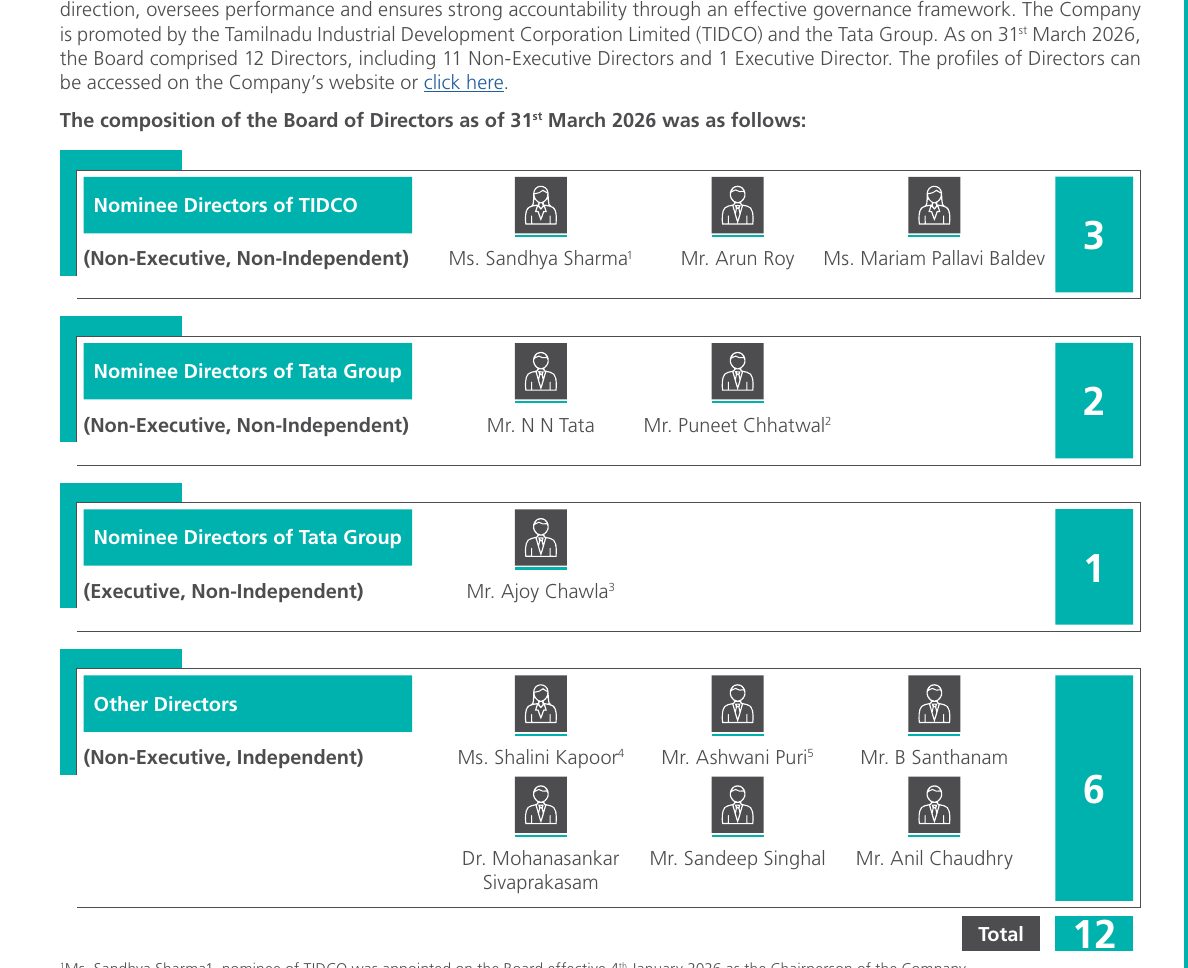
- Titan's board had 12 directors on 31 March 2026.
- Six of them are independent directors: exactly half the board.
Don't mix it up
the usual confusions
Independent director ≠ non-executive director
Every independent director is non-executive, but not every non-executive director is independent. A nominee of a big investor sits part-time but isn't independent.
Independent director ≠ auditor
An auditor checks the accounts from outside the board. An independent director sits on the board and votes on decisions.
Independent director ≠ KMP
KMP run the company full-time. An independent director must not have been KMP or an employee there in the last three financial years.
Three quick sips
no sign-up, nothing saved
Hindi mein
स्वतंत्र निदेशक (इंडिपेंडेंट डायरेक्टर)
इंडिपेंडेंट डायरेक्टर बोर्ड का वह सदस्य है जिसका कंपनी या उसके मालिकों से कोई कारोबारी, पारिवारिक या नौकरी का रिश्ता नहीं होता, ताकि वह बाहर की नज़र से जाँच सके और छोटे शेयरधारकों का ध्यान रखे।