
LODR (SEBI Listing Regulations) meaning in simple words
LODR: SEBI's rulebook for listed companies: what they must tell the stock exchanges, how fast, and how their boards must be run.

The story
two people, one chai stall
15 May 2026, during market hours. The board has just approved the FY26 results. Sameer stretches.
 Sameer
Done. Let's tell everyone tomorrow over chai.
 Riya
We have 30 minutes, not until tomorrow. The results and the ₹0.50 dividend go to the stock exchanges now.
SameerSays who?
RiyaLODR. SEBI's rulebook for listed companies. The Companies Act covers every company. LODR adds extra rules once you're listed.
SameerLike what?
RiyaResults every quarter within 45 days. Annual results within 60. We took 45. Big news, like a rating change or a new contract, goes out fast. And there are board rules: independent directors, an audit committee, approval for deals like your sister's milk.
SameerThat's a lot of homework.
RiyaIt's the price of the IPO money. Strangers own 40% of us. LODR makes sure they hear news when we do.
SameerFine. Send it.
RiyaAlready uploading.
The grown-up version
same idea, exact words
The SEBI (Listing Obligations and Disclosure Requirements) Regulations, 2015 apply to every listed entity. They require quarterly results within 45 days of the quarter's end and annual audited results within 60 days of the year's end (Regulation 33); disclosure of material events to the stock exchanges within set times, such as 30 minutes after a board meeting ends (Regulation 30 and Schedule III); quarterly shareholding patterns; and an annual report with a corporate governance report. Regulations 17 to 27 set governance rules on board composition, independent directors, committees and related party transactions; these don't apply to a listed company with paid-up equity capital up to ₹10 crore and net worth up to ₹25 crore. SEBI amends LODR often; for example, the related-party materiality thresholds changed from 19 December 2025.
Which rule asks for itSEBI (Listing Obligations and Disclosure Requirements) Regulations, 2015, as amended; made under the SEBI Act, 1992 and the Securities Contracts (Regulation) Act, 1956.
Spot it in the wild
a real annual report, a real page
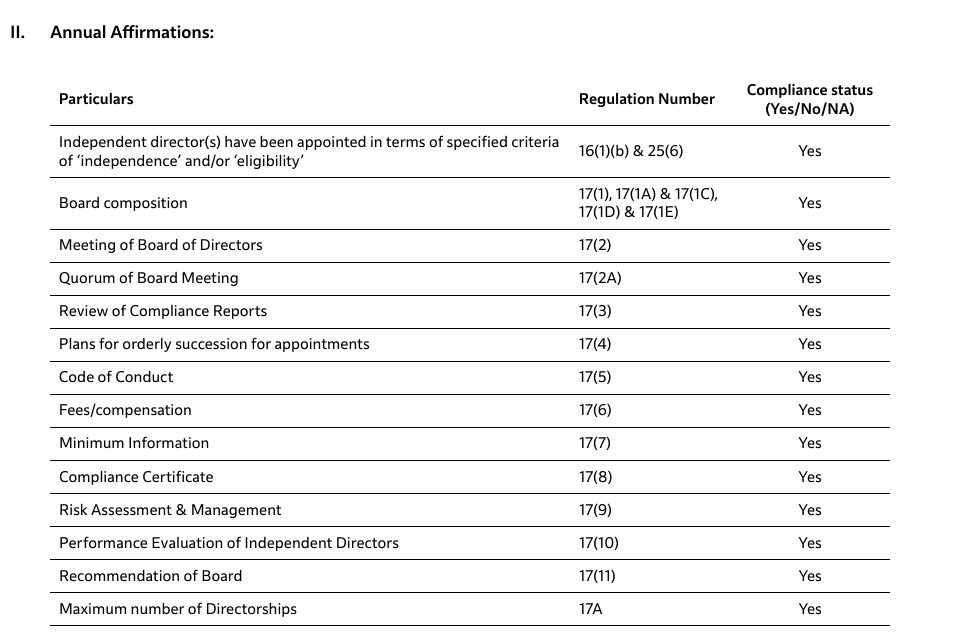
- Board composition: checked against Regulation 17(1) of LODR, and marked Yes.
- Even reviewing independent directors' performance has its own rule, 17(10).
Don't mix it up
the usual confusions
LODR ≠ Companies Act
The Companies Act, run by the Ministry of Corporate Affairs, applies to every company. LODR comes from SEBI and applies only once a company is listed, on top of the Act.
LODR ≠ listing agreement
Before LODR, companies signed a listing agreement with each exchange. LODR replaced most of it with one SEBI regulation in 2015.
LODR ≠ ICDR
SEBI's ICDR rules govern raising money, like an IPO or rights issue. LODR covers life after listing.
Three quick sips
no sign-up, nothing saved
Hindi mein

सेबी लिस्टिंग नियम (LODR)
LODR सेबी की नियम-पुस्तिका है जो बताती है कि लिस्टेड कंपनियाँ स्टॉक एक्सचेंज को क्या, कितनी जल्दी बताएँ, और उनका बोर्ड कैसे चले।