
Related party transactions meaning in simple words, with rules
Related party transactions: deals between a company and people close to it, such as its directors, top officers, their families or firms they control.

The story
two people, one chai stall
The CFO forwards a milk invoice to Riya. The supplier's name looks familiar.
 Riya
Sameer, this dairy belongs to your sister?
 Sameer
Yes. Best milk in town. We pay what everyone else pays.
RiyaThat's fine, but it's a related party transaction. A deal with someone close to you.
SameerIt's my sister's dairy, not mine.
RiyaDoesn't matter. The law counts a director's brother or sister as a relative, so buying ₹6 crore of milk from her is a related party deal, however fair the price.
SameerSo what happens?
RiyaOur audit committee must approve it first, and only the independent directors there get a say. They'll check it's at market rates.
SameerDo shareholders vote too?
RiyaOnly if it's "material". For us that's 10% of last year's group turnover. 10% of ₹128 crore is ₹12.8 crore. ₹6 crore is well below.
SameerGood. And if it crossed?
RiyaThen shareholders vote, and you sit that one out.
The grown-up version
same idea, exact words
A related party includes a company's directors and KMP and their relatives, firms and companies they are linked to, and group companies (Section 2(76)); SEBI's LODR also covers related parties under the accounting standard (Ind AS 24), the promoter group and holders of 10% or more of the equity. For listed companies, every related party transaction needs prior approval of the audit committee, given only by its independent directors. A transaction is 'material', and needs shareholders' approval with related parties not voting in favour, when it exceeds the Schedule XII threshold: for a company with consolidated turnover up to ₹20,000 crore, 10% of that turnover, with higher graded limits above that, capped at ₹5,000 crore. Under Section 188, deals in the ordinary course of business at arm's length don't need Board or shareholder approval under that section, but listed companies still follow Regulation 23.
Which rule asks for itSections 2(76), 177(4)(iv) and 188, Companies Act, 2013; Regulation 23 and Schedule XII, SEBI (LODR) Regulations, 2015 (thresholds as amended from 19 December 2025); Ind AS 24.
Spot it in the wild
a real annual report, a real page
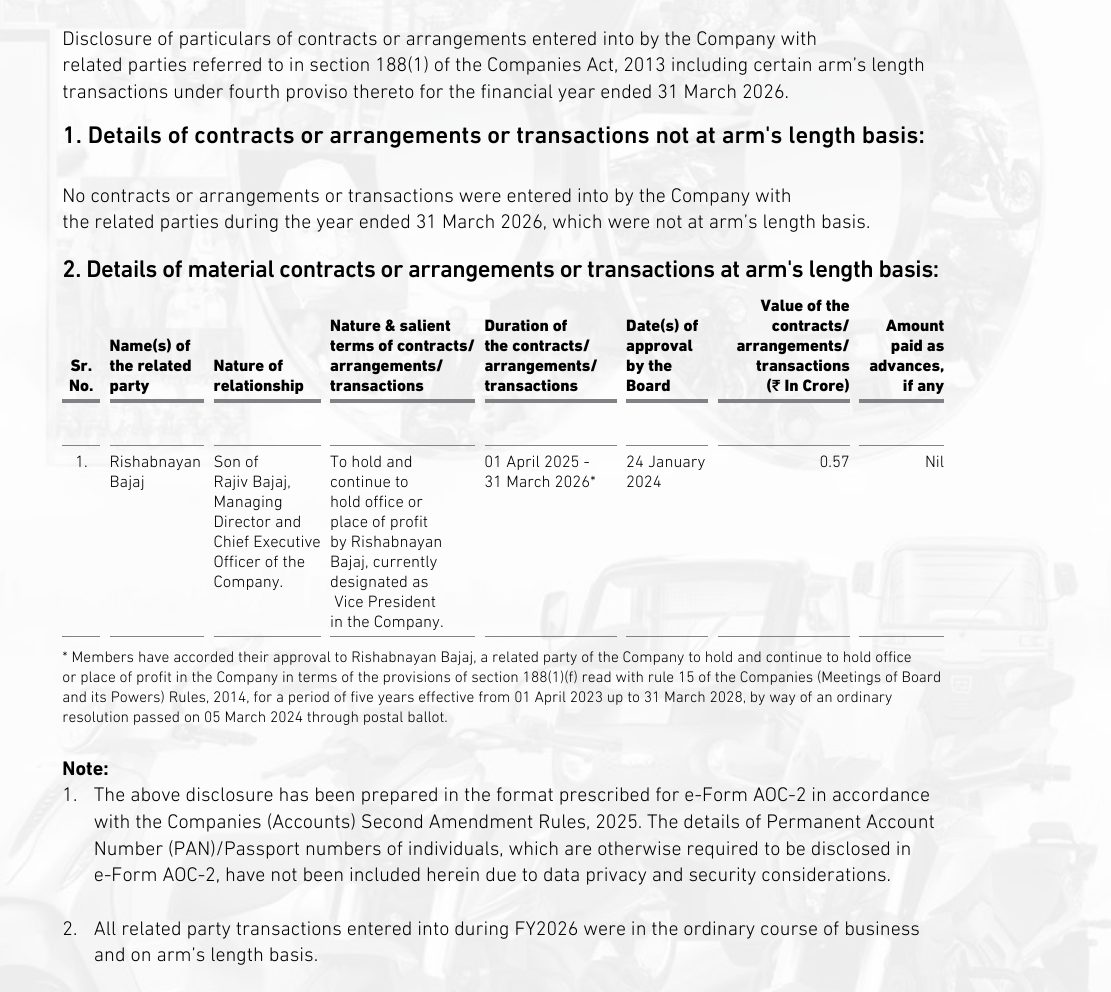
- The related party: the son of Bajaj Auto's MD and CEO, who holds a job in the company.
- The arrangement was worth ₹0.57 crore in FY26. Shareholders approved the role by postal ballot in 2024.
Don't mix it up
the usual confusions
Related party transactions ≠ fraud
A related party deal isn't wrong in itself. It's allowed if it's fair, approved by the right people and disclosed. The rules exist because it could be unfair.
Related party transactions ≠ arm's length price
Arm's length means the price strangers would agree. It's a test the deal must pass, not a kind of deal.
Related party transactions ≠ material RPT
Every related party deal needs the audit committee. Only 'material' ones, above the Schedule XII line, also need a shareholder vote.
Three quick sips
no sign-up, nothing saved
Hindi mein

संबंधित पक्ष लेन-देन (RPT)
रिलेटेड पार्टी ट्रांज़ैक्शन वे सौदे हैं जो कंपनी अपने क़रीबी लोगों से करती है, जैसे डायरेक्टर, बड़े अफ़सर, उनके परिवार या उनकी कंपनियाँ।