
Joint venture meaning in simple words: control shared by partners
Joint venture: a business that two or more partners run together under joint control, so no big decision can be taken unless all of them agree.

The story
two people, one chai stall
FY27, a "what if". A biscuit maker wants to open kiosks at railway stations with Sameer.
 Sameer
They make biscuits, we make chai, and every platform is full of hungry people. Perfect match.
 Riya
It would be a joint venture: a new company, owned 50:50. Each of us puts in ₹5 crore.
SameerWho's the boss?
RiyaNobody alone. Big decisions, like prices, the menu or new stations, need both partners to agree. That's joint control.
SameerSo it's half our subsidiary?
RiyaNo. A subsidiary is one we control on our own. Here control is shared, so the kiosks' sales won't be added to our revenue.
SameerThen where do they show up?
RiyaAs one investment line, starting at ₹5 crore. Each year we add our half of its profit, or take off our half of its loss. That's called the equity method.
SameerAnd if they want masala chai and we want cutting?
RiyaThen nothing gets sold until you agree. Put that in the contract.
The grown-up version
same idea, exact words
Under Ind AS 111, a joint arrangement is one that two or more parties control jointly: decisions about the relevant activities need the unanimous consent of the parties sharing control. It is a joint venture when those parties have rights to the net assets of the arrangement, usually through a separate company; Section 2(6) of the Companies Act, 2013 uses the same definition. In its consolidated statements, a joint venturer does not combine the venture line by line. It carries its interest as one investment under the equity method of Ind AS 28, adding its share of the venture's profit or loss each year, and reports the venture in Part B of Form AOC-1.
Formula
Investment in the joint venture = Cost + your share of its profits − your share of its losses − dividends you receive from it
Which rule asks for itInd AS 111, Joint Arrangements; Ind AS 28, Investments in Associates and Joint Ventures; Sections 2(6) and 129(3), Companies Act, 2013.
Spot it in the wild
a real annual report, a real page
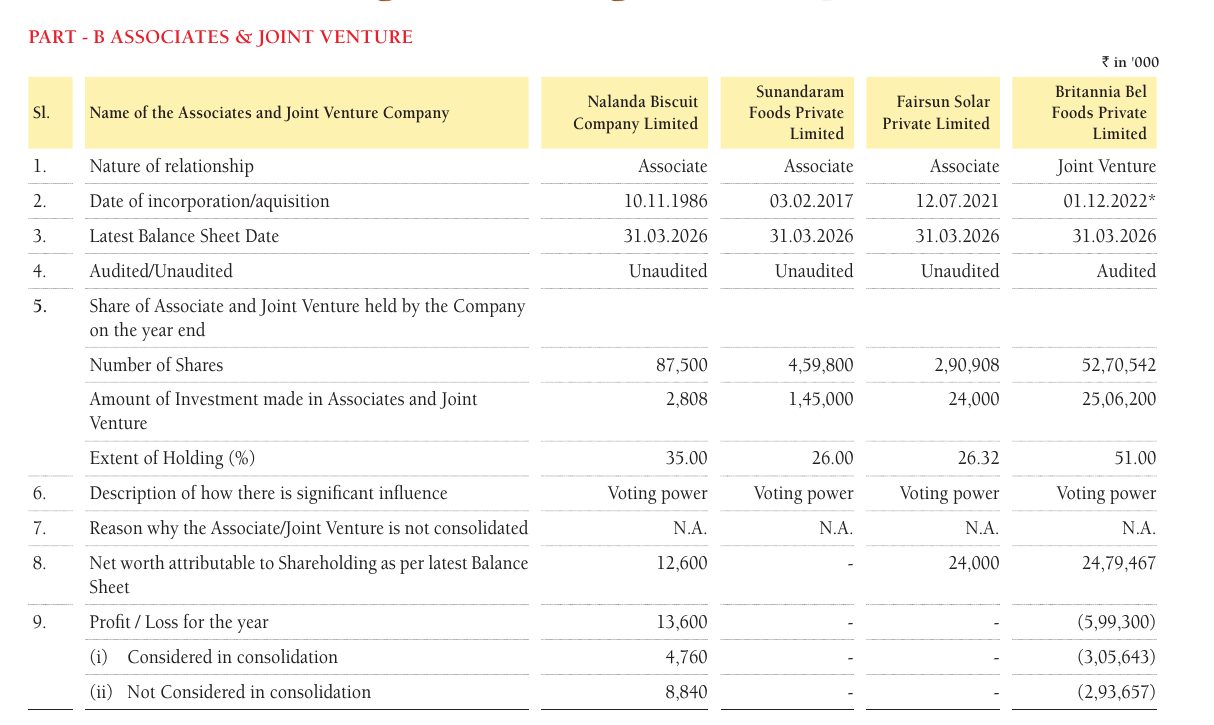
- Britannia Bel Foods is listed as a joint venture, with Britannia holding 51.00% of it.
- The joint venture lost about ₹59.9 crore. Only Britannia's share, about ₹30.6 crore, goes into its group accounts (figures are in ₹ thousand).
Don't mix it up
the usual confusions
Joint venture ≠ subsidiary
A subsidiary is controlled by one owner, so all its numbers are added in. In a joint venture control is shared, so only the owner's share of profit is added.
Joint venture ≠ associate
An associate is a company you only influence. In a joint venture you share control, and big decisions need your yes. Both use the equity method.
Joint venture ≠ joint operation
In a joint operation the partners own the assets and owe the debts directly, and each records its own share. A joint venture partner owns a share of a separate business's net assets.
Three quick sips
no sign-up, nothing saved
Hindi mein

जॉइंट वेंचर (संयुक्त उद्यम)
जॉइंट वेंचर वह कारोबार है जिसे दो या ज़्यादा पार्टनर मिलकर चलाते हैं, और कोई बड़ा फ़ैसला सबकी सहमति के बिना नहीं हो सकता।